
Sri Lanka’s Deepening Economic Crisis: The Plight of the Poor
By Lakshila Wanigasinghe:
Empty supermarket
shelves, endless queues to buy essentials and overnight camping around fuel
stations are now regular sights in Sri Lanka. As the economy continues to plummet with no viable short-term
solutions in sight, levels of frustration among the citizens continue to rise.
The country’s worst economic crisis since independence has battered Sri Lankans
from all walks of life but the fallouts are impacting the poor with greater intensity. If urgent measures are not taken to support the most vulnerable at
this time, more Sri Lankans will slip into poverty thus increasing
intergenerational poverty in the long term. This blog identifies some of the
most pressing challenges faced by the poor and vulnerable amidst the prevailing
crisis and outlines policy options to safeguard their well-being.
Background
Sri Lanka’s current economic
crisis is a result of several years of mismanagement, corruption, shortsighted
policymaking, and an overall lack of good governance. Insufficient foreign
reserves at Sri Lanka’s
Central Bank and loss of access to international capital markets resulted in
the country defaulting on debt for the first time in history. Unchecked external
borrowings, tax cuts that widened the existing budget deficit, the chemical
fertiliser imports ban and the sudden floating of the Sri Lankan rupee are
among several factors that contributed to the economic collapse. Tourism, together
with apparel and tea exports – some of Sri Lanka’s main income sources –
were affected in recent years due to various internal
and external factors such as the 2019 Easter Sunday attacks followed by
COVID-19 in 2020. Now, the economic crisis presents multiple challenges
including severe threats to nutrition, food security, healthcare, and
education.
Impacts on the Vulnerable
The rapid depreciation of the Sri Lankan
Rupee and the inability of wages to keep up with inflation have drastically
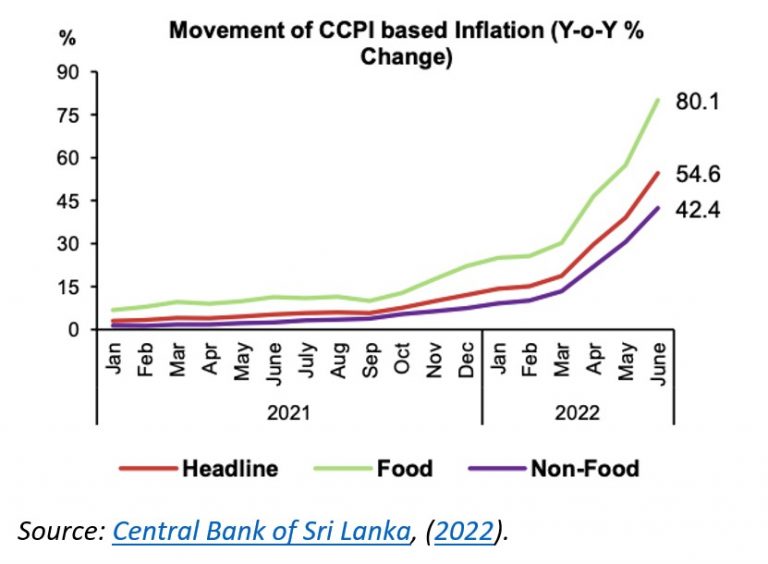
lowered the standard of living. Inflation, as measured by
the Colombo Consumer Price Index (CCPI) for June 2022, was 54.6% in comparison
to 39.1% in the previous month. Further, food inflation rose to an alarming
80.1% in June 2022.
The ability to earn a living wage is
hampered by insufficient fuel supplies. This along with the rise in transport
costs and overcrowded public transport have left workers struggling to commute
to work. Daily wage earners such as three-wheel drivers are in fuel queues for
days losing out on productive work hours. Regular interruptions to the power
supply are affecting small-business owners’ ability to conduct business and with
many completely shutting down operations. Shortages in gas and kerosene oil for
cooking, rise in commodity prices and supply shortages are changing people’s
consumption patterns forcing many families to reduce their consumption
and non-consumption expenditure. The inability to receive adequate nutrition due
to increases in the cost of living is affecting children’s health and may lead
to increased rates of malnutrition in the future. Apart from this, continuous
school closures are impeding children’s education, especially at the village level
where most families lack the technology for digital learning.
Short-term Relief
Sri Lanka was facing a reversal in
poverty levels since the COVID-19 pandemic and faces the risk of many new
groups following suit along with those who are already poor falling deeper into
poverty. Hence immediate measures must be taken to support the poor and ensure
their livelihood sustenance to some extent. As the current fiscal restrictions
pose a challenge in supporting all groups in need, emergency relief efforts
need to be targeted toward the most vulnerable so as to not further cripple the
economy. Providing cash transfers is one such relief option. They were widely popular as a
global emergency response during COVID-19. While Sri Lanka also adopted this as a
response to the pandemic, the key in this context would be to provide an
adequate sum of money to the most deserving households. Although this may
include a considerably large number of at-risk families due to rising
inflationary pressure, unfortunately only those in dire need of support must be
beneficiaries at this time. As such authorities will have to make tough choices
to correctly identify deserving households. Financing these cash transfers will
require an allocation of a portion of funds from foreign aid, loans and other humanitarian assistance received by Sri Lanka.
Following the declaration of a three-day weekend
for public sector employees, primarily to utilise their time to cultivate
consumable crops at the household level, the provision of in-kind support such
as seeds and fertiliser for cultivation is another option. As with monetary
support, these initiatives must be targeted toward the poorest who are unable
to meet their required nutrition levels. However, there is an issue with such
families not having suitable plots of land for cultivation. Thus, initiatives
need to be thought of on how to overcome space limitations. One option is through
community gardens which can be introduced in village-level Grama Seva offices,
school grounds etc. Proper organisation, allocation, and monitoring are
imperative to successfully execute these initiatives.
Although an unpopular solution, temporary rationing measures will need to be put in place, especially for high-demand commodities such as fuel, gas, milk powder and medicine etc. Lakshila Wanigasinghe is a Research Officer at IPS with research interests in poverty, social welfare, development, education, and health. She holds an MSc in Economics with a concentration in Development Economics and a BA in Economics with concentrations in International, Financial and Law and Economics from Southern Illinois University Carbondale (SIUC), US. (Talk with Lakshila – lakshila@ips.lk)
This will help curb excess purchasing of items and ensure all individuals have access to purchase necessities.
Excessive purchasing often leaves the poor on the losing end since they do not have sufficient funds to purchase beyond their immediate requirements. Hence rationing will help with maintaining sufficient supplies for low-income groups such as daily-wage earners. While it is important to support the poor and vulnerable at this time, it is imperative to ensure the limited fiscal and other resources are used effectively. Further, these measures need to be taken alongside working towards ensuring political stability and debt sustainability to restore international confidence in Sri Lanka. This will encourage support from the global community to help Sri Lanka work towards overcoming this crisis.