
Opinion: Ban on tobacco cultivation: A blessing in disguise for Sri Lankan farmers
By Manoj Thibbotuwawa and Nimesha Dissanayaka
While the
topic of tobacco control is mentioned in some of the main presidential
candidates’ manifestos, it is uncertain whether they will honour the commitment
made in 2017 to ban tobacco cultivation by the end of 2020. All these promises come
at a time when it is widely believed that tobacco control will destroy the
livelihoods of smallholder tobacco farmers. The support and security given by the
Ceylon Tobacco Corporation (CTC) – which enjoys
a monopoly on tobacco trade in Sri Lanka – to farmer communities through
contract farming systems, have convinced some farmers to continue cultivating
tobacco.
Since two third of the transition period of the proposed cultivation ban
has already lapsed, it is unclear whether the shift from tobacco will be
achieved by the end of 2020. Another concern is whether the 2019 presidential election
will be an opportunity for lobby groups to convince policymakers to reverse the
proposed ban. In such an uncertain policy environment, this blog examines the
possibility of switching to alternative crops. It
looks at the potential economic impacts of the ban on tobacco farmers and argues
that helping small farmers switch from tobacco to alternative crops can
be a means of uplifting rural livelihoods.
Falling Demand for Growing Tobacco
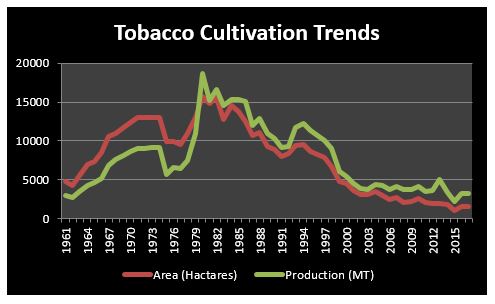
FAOSTAT data indicate that both tobacco production and the cultivated area in Sri Lanka have decreased significantly over the last few decades, dropping by more than three-quarters since 1980. Approximately 0.68 per cent of agricultural land, equivalent to 15,594 hectares, was under tobacco cultivation in 1982. However, the latest statistics indicate a cultivated area of 1,338 hectares, a mere 0.06 per cent of agricultural land in 2018. This highlights a drastic decline in the importance of tobacco in the cultivated crop mix. The production too has declined dramatically, from 16,670 MT in 1982 to 3,273 MT in 2017. While banning tobacco cultivation in environmentally sensitive areas and decreasing state support for tobacco cultivation might have played a part in this declining trend, it can be attributed mainly to declining demand for cigarettes due to rising prices with increased taxation.
Furthermore, the number of farmers who are
directly involved in tobacco cultivation is miscalculated. According to the
Minister of Industry and Commerce about
200,000 farmers are directly involved in tobacco cultivation, while the Barn Owners
Association quotes a figure of just 20,000
direct farmers who will be required to switch to alternative crops in 2020. Meanwhile,
the Ministry of Agriculture estimates that only about 3,000
farmers
currently cultivate tobacco in Sri Lanka.
Many tobacco farming households do not rely on tobacco as a main income source.
Instead, tobacco farming provides a supplementary income to farmers, that is a
small share of the total household income.
Alternatives for Tobacco
Tobacco is considered to be a viable cash crop because
of the high profits it generates, the availability of a significant market, and
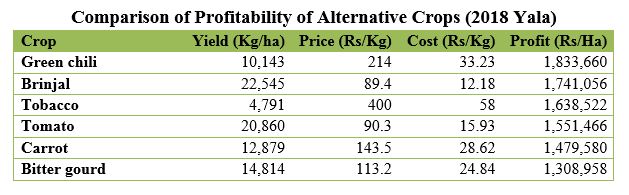
the ease of cultivation. Based on authors’ calculations, an average farmer
received an approximate profit of Rs. 1,638,522 per hectare in the 2018 Yala season,
considering upper limit values of CTC for the farm-gate price. But, further analysis
shows that there are several potential alternative crops that can be cultivated
under the same agro-ecological conditions and generate comparable profits for tobacco, including green chili and certain vegetables. Also,
perennial crops such as papaw, guava, and grapes can be suitable alternatives, as
they generate year-round incomes and high profits, incur a low cost of
cultivation, and require less labour.
Comparison of Profitability of Alternative Crops (2018
Yala)
| Crop | Yield (Kg/ha) | Price (Rs/Kg) | Cost (Rs/Kg) | Profit (Rs/Ha) |
| Green chili | 10,143 | 214 | 33.23 | 1,833,660 |
| Brinjal | 22,545 | 89.4 | 12.18 | 1,741,056 |
| Tobacco | 4,791 | 400 | 58 | 1,638,522 |
| Tomato | 20,860 | 90.3 | 15.93 | 1,551,466 |
| Carrot | 12,879 | 143.5 | 28.62 | 1,479,580 |
| Bitter gourd | 14,814 | 113.2 | 24.84 | 1,308,958 |
There are certain factors that have led to farmers continuing to grow tobacco, despite the availability of alternatives. Most of the farmers who cultivate tobacco are under a contract with the CTC. Having a readymade market for their crops, with some additional benefits such as free extensions, is one of the main perks of tobacco cultivation. Also, tobacco plants are more resilient to droughts as they require less water.
Why Switch from Tobacco?
Apart
from the negative health impacts and costs to society due to the consumption of
tobacco, there are some disadvantages of growing tobacco, such as high initial capital investment, long crop duration,
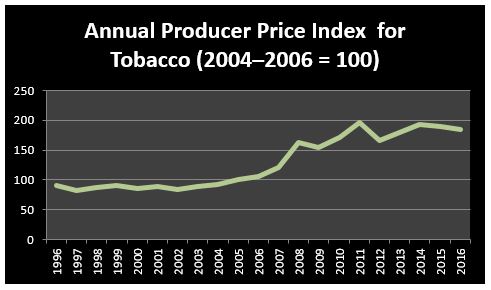
and high labour requirement. Over the past decade, the
price of tobacco has fluctuated dramatically, showing steady increases and
little variance from 1996 to 2007, but becoming much more unpredictable from
2008 to 2016. While there is an overall upward producer price trend due to production
decline and the rise in cigarette prices, the
available data also indicates a
high price risk and uncertainty
for Sri Lankan tobacco farmers, even with a contract farming system, due to the
monopolistic price decision power of the CTC.
Tobacco is a nonfood crop that is grown in home
gardens and is in direct competition with food-crops grown in home gardens. This
has negative implications for government policy on promoting home gardening to
ensure food and nutrition security. Other than that, the widespread cultivation of tobacco
decreases soil fertility, which is costly for farmers.
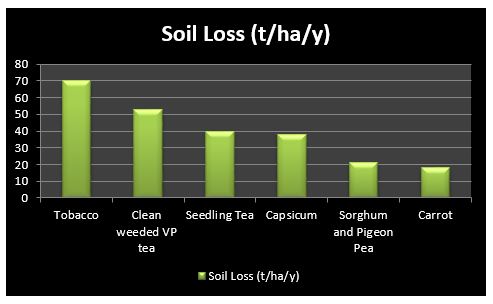
In fact, tobacco heavily contributes to environmental degradation, with an estimated soil
loss of 70 Mt/ha/yr
in Sri Lanka.
Way Forward
The most pressing challenge at present is the prevailing myth that
tobacco control destroys the livelihoods of smallholder tobacco farmers. However,
in reality its negative social and environmental impacts
far outweigh the immediate benefits touted by the tobacco industry. Therefore, evidence-based research
is crucial to prove that switching out of tobacco farming would in fact improve
the livelihood of farmers.
On a positive note, there is a
favourable policy environment for getting farmers to switch to alternative
crops which not only contributes to the export revenue and farm income, but
also improves food security. For example, tobacco cultivation has been
sidelined to accommodate agribusiness partnerships for high value food crops in
the economic development strategy presented in the “Vision
2025”.
Also, the “National
Export Strategy (NES)”, which provides the roadmap to achieve Sri Lanka’s export vision, has paid
special attention to food and beverage crops which could be better alternatives
for tobacco. Also, neither the current
agricultural policy nor the draft
overarching agricultural policy 2019 of the government
views tobacco cultivation as a strategic priority.
Therefore,
it is very important to identify
profitable alternatives as
priority sectors for reviving
domestic farm-market linkages for rural economic development and export growth and to farmers proper guidance and support to gradually switch to those alternatives.
(Manoj Thibbotuwawa is a Research Fellow and
Nimesha Dissanayaka is a Research Assistant at the Institute of Policy Studies
of Sri Lanka (IPS). To talk to the author, email manoj@ips.lk
/ nimesha@ips.lk. To view this article online and to share your comments, visit the IPS
Blog ‘Talking Economics’ – http://www.ips.lk/talkingeconomics/)