
Opinion: Gender dimension of remittances to Sri Lanka: Who remits more?
Bilesha Weeraratne
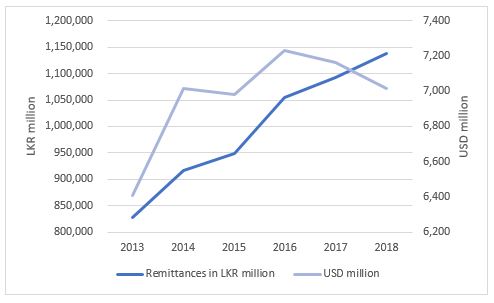
Remittances are often considered a stable and a reliable source of development financing. In 2018, remittances to Sri Lanka totaled to USD 7.015 billion. At the macro level, the contribution of remittances to the Sri Lankan economy is immense. In 2018, remittances accounted for 7.8 % of the GDP, and could cover 59% of the total import bill of USD 11.89 billion, or over 13% of Sri Lanka’s outstanding external debt (USD 52.31 billion). Nevertheless, in 2015, remittances to Sri Lanka declined for the first time in the recent years, and then 2017 and 2018 saw a steady downward trend.
While much is known about the macro level contribution of remittances, relatively little is known about the finer details. This blog aims to shed light on the gender aspect of remittances, derived mainly from micro level data, to identify strategies to improve the country’s remittances in the future.
Declining Remittances
In
2017, remittances to Sri Lanka declined by 1.08%, compared to the previous year,
while the decline in 2018 was 2.08%. The Central Bank of Sri Lanka attributes this
decline to the ‘prevailing geopolitical uncertainties in the Middle
East region, due to fluctuations in oil prices and sluggish global growth’ and
the decline in departures for foreign employment. Nonetheless, an underexplored reason for the decline
in remittances is the recent changes in the composition of migrant workers from
Sri Lanka.
Due
to targeted policy efforts since 2013, the share of female migrant workers is
less than that of males; at the same time, this has resulted in a decrease in the
share of female domestic workers among migrant worker departures.
Average
Remittances
A recent
study by the author examined the
gender specifics in remittances to Sri Lanka. The study involved a sample
survey of 669 migrants in 602 households in Kurunegala, Batticaloa, and Colombo
in 2018. The average size of remittances to Sri Lanka in this sample was LKR
39,550, and the most common frequency of remitting was once a month.
Gender
and Remittances as a Share of Income
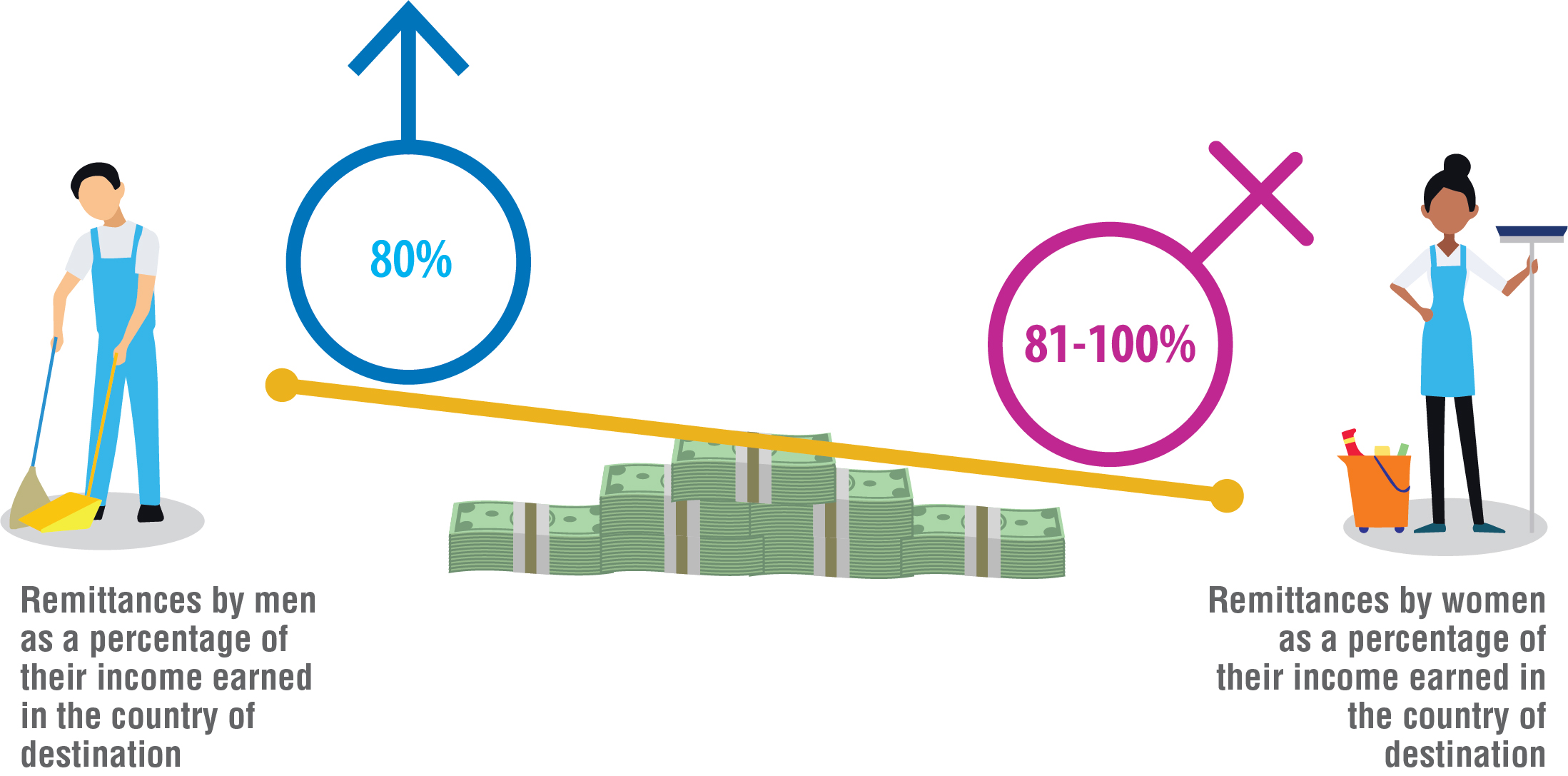
The study also found some important gender distinctions in remittances to Sri Lanka. In this sample, men remitted up to 80% of their income earned in the country of destination.
On the contrary, when it comes to females, a majority remitted a higher proportion, ranging from 81-100% of the income earned in the country of destination. The disparity between men and women in the share of income remitted indicated that women are less likely to save for themselves in the country of destination, and instead transfer all their savings as remittances to the family left behind. Correspondingly, more males retain up to about a fifth of their income in the country of destination, without remitting to Sri Lanka. It is unclear if males spend this portion of their income at the country of destination or save and bring it back in bulk upon returning to Sri Lanka.
Macro
level data indicates that the females’ tendency to remit a larger proportion of
income earned from foreign employment could be driven by their involvement in
domestic employment. For instance, out of the 81,685 female departures in 2018,
almost 80% were for domestic work, where food and lodging are provided free of
charge by the employer.
Gender
and Value of Remittances
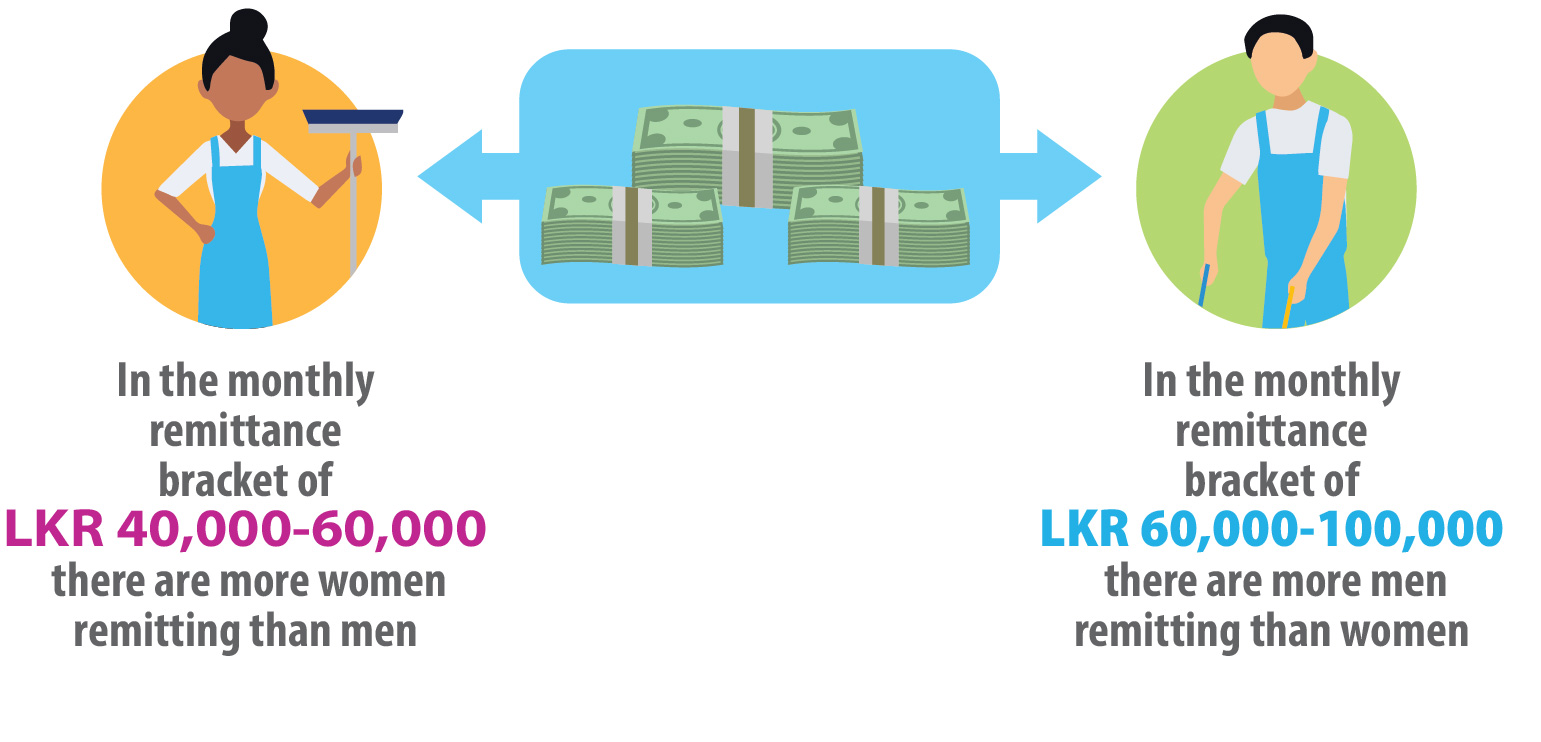
As per study findings, up to the average amount of remittances (LKR 40,000 a month), there are a similar percentage of men and women remitting. However, implying the possibility of female migrants from Sri Lanka earning less than males, the study finds that in the monthly remittance bracket of LKR 40,000-60,000, there are more women than men. On the contrary, in the higher monthly remittance bracket of LKR 60,000-100,000, there are more men remitting than women.
These
findings are consistent with international literature, which indicates that
when they do remit, men remit higher amounts than females, possibly due to
possessing higher skills, leading to better jobs and higher wages.
Departures
and Remittances
During
the last 10 years, the share of females among migrant departures have declined
from 52% in 2009 to 39% in 2018. Similarly, the share of female domestic
workers among all departures have declined from 46% in 2009 to 31 % in 2018. At
the same time, the share of female domestic workers among all females was much
higher at 88% in 2009. These macro statistics show that the dominance of
females have been on the decline during the past decade. Nevertheless, the
findings of the study based on micro data indicates that females are important
when it comes to remittances. As such, policy formulation for revising the
composition of labour migrants should also give due attention to the gender
dimensions in remittances, for one of the key returns to Sri Lanka from labour
migration is the remittances sent by migrants.
Increasing
Remittances
Given
that the findings of the study indicate that females are already accustomed to
remit large proportions of their income to Sri Lanka, it is important to re-examine
the remittance implications of restricting female migration, and especially of female
domestic workers.
At
the same time, it is necessary to encourage males to remit a greater share of
their income from foreign employment. To this effect, predeparture training
needs to place more emphasis on educating male migrants about the importance of
remitting.
Finally,
most remittances to Sri Lanka are still sent out of necessity by migrants who
have family left behind. But, with the promotion of skilled migration for
higher paid jobs, skilled migrants often leave as a family, with no one behind
to receive remittances. For this group of migrants, remitting is often optional.
The remittance market in Sri Lanka has not yet tapped this potential pool of
remitters. In order to make remittances to go beyond mere necessity, the
financial sector needs to make remitting attractive by associating benefits for
remittances and making remittance sending and receiving quick, easy, and hassle
free.(Bilesha Weeraratne is a Research Fellow at
the Institute of Policy Studies of Sri Lanka (IPS). To talk to the author,
email bilesha@ips.lk. To view this article
online and to share your comments, visit the IPS Blog ‘Talking Economics’ – http://www.ips.lk/talkingeconomics/