
Working remotely in the age of COVID: Who is left behind?
By Nisha Arunatilake and Chamini Thilanka
The COVID-19 pandemic
which was first
reported in Sri Lanka in January
2020 has distressed the country’s labour market. According to the Department
of Census and Statistics, with the onset of the pandemic, the
labour force participation has decreased and the unemployment rate has
increased, indicating reduced job openings. For example, the labour force
participation rate decreased from 51.1% to 50.2% and the unemployment rate
increased from 4.6% to 5.4% from second quarter (2Q) 2018 to 2Q 2020. This is
partly due to the measures taken since mid-March to contain the spread of
COVID-19 through curfews and lockdowns.
To continue economic
activities under such constraints, the Sri Lankan government advised full or
partial work from home (WFH) policies. For many businesses and workers, WFH
practices are a new experience. Further, not all workers are able to
effectively carry out WFH (Saltiel, 2020). The
practicality of WFH depends on three main factors. One, the nature of the work
and the possibility of conducting job-related activities from home. Two, the
capability of the management and workers to adapt to WFH. Lastly, the
availability of information and communications technology (ICT) infrastructure
and access to the internet for both the workers and businesses.
Better information on
the types of workers who are able to continue to carry out their tasks from
home can help the government to design policies to reduce disruptions to
economic activities. This blog examines the plausibility to WFH for different
types of workers in Sri Lanka.
COVID-19 and the ‘new
normal’
Labour market
disruptions induced by COVID-19 is not unique to Sri Lanka. According to the
International Labour Organization (2020), around 68%
of the total workforces, including 81% of employers, live in countries with
recommended or required workplace closures. As per ILO estimates, just 18% of
workers have occupations suitable for WFH and reside in countries with the
infrastructure necessary to enable this practice. These statistics indicate
that the numbers of occupations that are affected or minimally affected by
social distancing measures are large, while the majority of occupations cannot
be performed from home.
According to Dingel and Neiman (2020) and Mongey and Weinberg (2020), even in advanced countries with very good ICT
infrastructure coverage such as the United States, only 37% of jobs can
practically be performed entirely at home, although there are substantial
differences across cities and industries. Besides, a country-specific result
indicates that countries with lower income levels are less likely to adapt to
WFH mode, resulting in a lower share of jobs that can be performed at home.
In an attempt to assess
the plausibility to WFH, Dingel and Neiman (2020) classified occupations based
on information gathered from surveys. The plausibility factor was determined
based on the physical and social factors that influence the nature of work
(e.g., frequency of using e-mails, frequency of job related out-door
activities, etc.) as well as tasks performed at work (e.g., handling vehicles,
controlling machines, working directly with public, etc.). By mapping the
plausibility to WFH shares compiled by Dingel and Neiman (2020) to Sri Lanka’s
Labour Force Survey data, it is possible to assign plausibility to WFH shares
to occupations in the country.
The ability to WFH
varies between 0 and 1, where 0 indicates occupations that cannot be done from
home at all, while 1 indicates occupations that can entirely be done from home.
Occupations that can be partially done from home are indicated by a number between
0 and 1, where a number closer to one indicates an occupation that can mostly
be done from home, while a number closer to zero indicate an occupation which
can minimally be done at home.
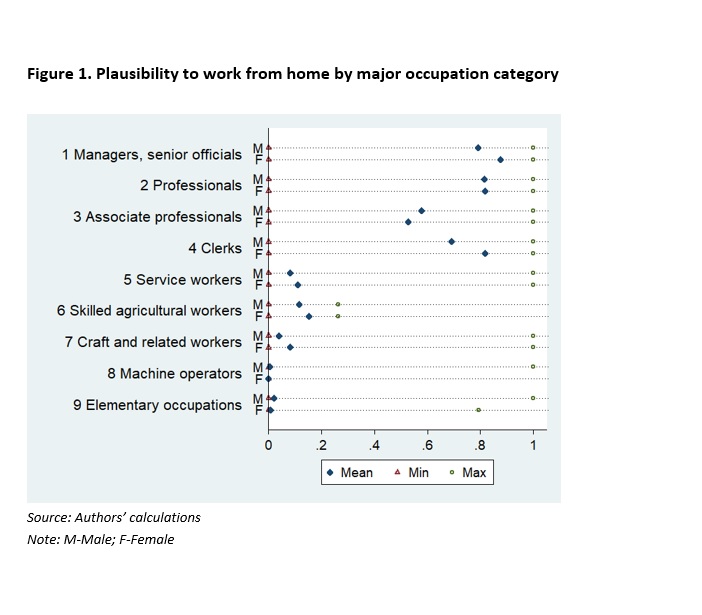
The results show that on average (see mean values of Figure 1), the ability to WFH vary widely across occupational groups. Further, the plausibility to work from home is more for females than for males. This is possible due to the fact that women choose desk jobs. The data also clearly shows that workers in occupation groups requiring low skill levels are less able to WFH, while workers in high-skilled occupation groups are more able to WFH. However, other than for workers in skilled agriculture, at least some workers in all other occupation categories can work remotely.
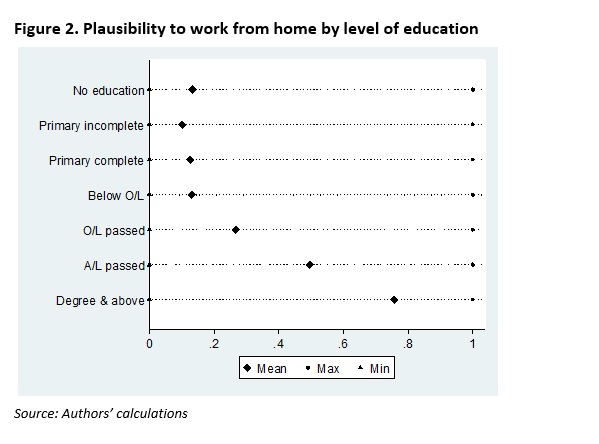
Figure 2 shows how plausibility to WFH varies by skill level. As seen, workers with at least a degree are most able to WFH. While the plausibility to WFH decreases for workers with lower levels of education.
The
above analysis illustrates the plausibility to WFH for different types of
workers in Sri Lanka. However, the actual number of workers who can WFH will
not only depend on the work context and the nature of the job, it will also
depend on the ability of the management to organise work so workers are able to
WFH as well as their access to ICT infrastructure.
Way Forward
The government can
improve WFH activities by supporting firms to organise WFH, and by improving
access to WFH. As mentioned earlier, the nature of work and job-related
activities only provides the plausibility of workers to WFH. For workers to
actually WFH, managers of institutions must facilitate this by organising
online reporting and monitoring mechanisms. Given that the concept of offsite
work is new to Sri Lanka, not all managers will have the knowledge to
facilitate WFH opportunities for their workers. The government can design
policies to support such institutions.
The results also suggest
that facilitating WFH may be a way to increase female labour force
participation, as they have a higher likelihood of WFH. Further, access to ICT
infrastructure and fast connectivity are essential to effectively WFH. Reducing
gender inequalities in access to ICT can also improve economic activities under
WFH, and increase female labour force participation.
Moreover,
policies to improve the coverage of good quality ICT infrastructure can also
increase the effectiveness of WFH.
Meanwhile, given the nature of employment, workers in some occupations will find it challenging to WFH, and alternative strategies must be used to keep these workers active. Some examples of such strategies include working under strict social distancing measures and providing better protective gear to mitigate health risks.
Nisha Arunatilake is the Director of Research at IPS. Her research interests include Econometrics and Economic Modeling, Education, Health, Labour & Migration, National Government Expenditures, Poverty and Development Policy, Social Security and Public Pensions, Taxation, Subsidies, and Revenue. She holds a BSc in Computer Science and Mathematics with summa cum laude from the University of the South, USA and an MA and PhD in Economics from Duke University, USA. (Talk with Nisha – nisha@ips.lk)
Chamini Thilanka was a Research Assistant at IPS. She holds a BA and an MA in Economics from the University of Peradeniya. She is a Visiting Lecturer at the Open University of Sri Lanka.