
Mitigating Sri Lanka’s COVID-19 Education Crisis: Priority Areas for Action
By Ashani Abayasekara and Thisali de Silva
The year 2020 saw close to 1.6 billion students from over 180 countries being kept out of schools for extended periods of time, in response to the COVID-19 pandemic. Despite commendable efforts by many countries to put in place alternative remote learning strategies and corrective measures, learning losses have been unavoidable and substantial. The UNESCO Institute for Statistics estimates that by early November 2020, the world student population had lost between 41% and 68% of in-person schooling they would have received under usual circumstances.
In this second year of the pandemic, many countries are
moving from emergency responses towards policies aimed for recovery. Along with
reopening schools and resuming education, these also include tailored support
to help students adjust to learning in the new normal, and remedial measures to make up for
lost learning.
Sri Lankan schools have been largely dysfunctional for over
15 months since initial closures in March 2020, despite some brief periods of
operation. This blog examines policy responses adopted in Sri Lanka’s education
sector over the past year, with a view of informing its future education
recovery strategy in 2021 and beyond.
School Closures
in Perspective
As
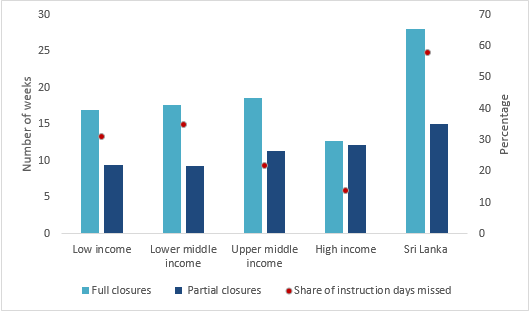
of March 2021, Sri Lankan schools are estimated to have been fully closed for
28 weeks and partially closed for 15 weeks. As shown in Figure 1, these
numbers– especially of full closures – and as a result, the share of total
school days missed, are significantly higher compared to all country income
group averages. These figures are likely to considerably increase further,
given the current indefinite closures following the third wave of the pandemic.
Figure 1: Duration of School Closures in Sri Lanka and by Country
Income Group, March 2020 – March 2021
Immediate Response: Distance Education
The
government’s response to current school closures is to encourage schools to
continue and further expand online programmes which have been in operation
since last year. However, as cautioned in a previous
IPS blog, online learning platforms in Sri Lanka
suffer from issues of access and quality, also confirmed by estimates
of a recent survey conducted among public school
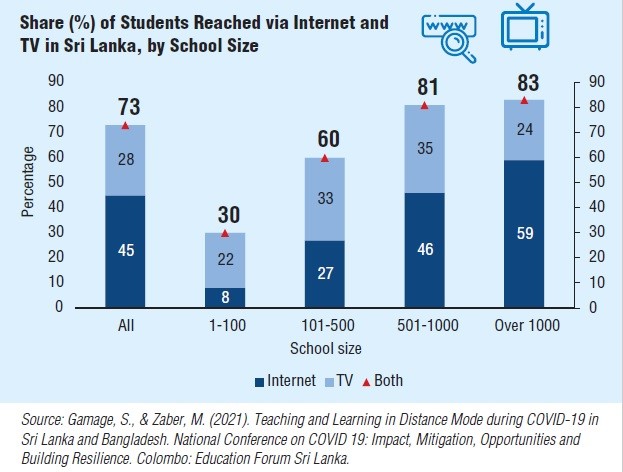
teachers and parents across the country. As Figure 2 shows, less than 50% of students
were reached online on average; further, it ranged from a low of 8% in the smallest
schools – which are typically the least privileged – to 59% in the largest.
The
survey also indicates that education via TV proved to be a better way of reaching
students in smaller schools. However, several pedagogical and logistical
challenges have hindered effectiveness. These include lack of links between
televised programmes and teachers’ lesson plans; a passive teaching style and
absence of interaction with students; confusion of timing and duration of
different subjects and TV channels; and poor communication of programme
information to schools, students, and parents.
Figure 2:
Long-term
Response: Recovery Strategies
The
government’s strategy for recovering learning losses in the longer-term also
remains unspecified. Interviews conducted with education sector stakeholders
revealed that some privileged schools have initiated remedial measures at the
school-level, leveraging available resources and support from community
networks.
These
include: (1) assessing student learning via Google Form assessments and telephone
follow-ups; (2) monitoring student progress on attendance, work submitted, and marks
obtained for assessments; and (3) reducing curricula content to help students
and teachers cope better. Apart from lower access to resources, centralised
decision-making has made it difficult to implement similar school-level
measures in less-privileged schools.
Areas
for Urgent Action
The
above discussion suggests that both emergency and recovery measures adopted in
Sri Lanka during COVID-19 school closures have worsened existing education
inequities. To alleviate the current education crisis and commit to leaving no
one behind, urgent action is needed in the following areas:
Reopen schools in low-risk
areas
It is useful to consider
opening schools in remote COVID-19 low-risk areas where distance learning is
neither accessible nor effective, which usually have smaller student
populations, allowing for better adherence to health guidelines such as
physical distancing.
This can be done by
allowing schools to make decisions in discussion with relevant school
committees and regional education authorities, as opposed to blanket decisions
made at the central level for all schools. Such plans should also involve
strategies for more permanent ways of keeping schools open, supported by
regular cost-effective testing of both teachers and students, and vaccinating
teachers as a priority group.
Continue
hybrid learning when schools reopen
The periodic interruptions to
school reopening attempts underscore the need for a well-developed hybrid
system for education delivery – consisting of a mix of in-person and remote
options – so that teachers and students can shift smoothly to distance learning
during an emergency. Even when schools are open, safety measures would not
permit all students to attend school daily in highly-populated schools,
necessitating blended learning to ensure uninterrupted learning. Recent
research based on different country experiences shows that effective hybrid
learning can be offered in any setting, by identifying the best combination of
education modalities, learning material, and methods of communication, in line
with available resources, skills, and technology.
Improve pedagogy for distance
learning
Distance education is here to stay in some form or the
other, at least in the foreseeable future. Ensuring effective remote pedagogy is
particularly challenging for TV broadcasts as opposed to online teaching, where
programme design has to ensure continuity in the face of the central
teacher. Given that TV is the most
feasible way of reaching less-privileged students in Sri Lanka, is it crucial
to address existing pedagogical and logistical issues.
Reviewing measures taken in countries such as Pakistan
and Vietnam
to overcome similar challenges can be useful in this regard. These include:
*This blog is based on the comprehensive chapter on education in IPS’ forthcoming ‘Sri-Lanka: State of the Economy 2021’ report.
Ashani Abayasekara is a Research Economist at the Institute of Policy Studies of Sri Lanka (IPS) with research interests in labour economics, economics of education, development economics, and microeconometrics. She holds a BA in Economics with First Class Honours from the University of Peradeniya and a Masters in International and Development Economics from the Australian National University.
.
Thisali de Silva is a Research Assistant at IPS. She holds a BA in Economics with First Class Honours from the University of Colombo. She is the first recipient of the Saman Kelegama Memorial Research Grant, awarded by IPS, for her research on three-wheeler drivers in Sri Lanka. Thisali holds a Diploma in Applied Statistics from the Institute of Applied statistics, Sri Lanka (IASSL) and a Certificate in Business Accounting-CIMA.
Sources: UNESCO.
(2021). Education: From Disruption to Recovery. Retrieved from https://en.unesco.org/covid19/educationresponse#durationschoolclosures ; UNESCO, UNICEF & World Bank. (2020). UNESCO-UNICEF-World
Bank Survey on National Education Responses to COVID-19 School Closures – Key
Results (2nd Iteration).