
Private Tutoring Amidst Sri Lanka’s Economic Crisis: Issues Faced by Students
By Usha Perera
Sri
Lanka’s education sector, still reeling from the effects of the COVID-19
pandemic, now faces acute challenges due to the current political and economic
crises. The sudden imposition of curfews and the lack of transportation have
resulted in school closures and students being deprived of structured and
systematic in-school education. In Sri Lanka, closing schools for just one day
causes a loss of 25 million learning hours and 1.4 million
teaching hours. Alongside
this, private tutoring has gained greater importance. This blog discusses the
issues faced mainly by Ordinary Level (O/L) and Advanced Level (A/L) students
in attending tuition classes based on an IPS study.
The study findings are
derived from a sample of about 340 students, and 16 teachers and tutors across Sri
Lanka.
Affordability
of Private Tuition Classes
The
surge in the cost of living with wages failing to keep pace with inflation and loss of income generation channels
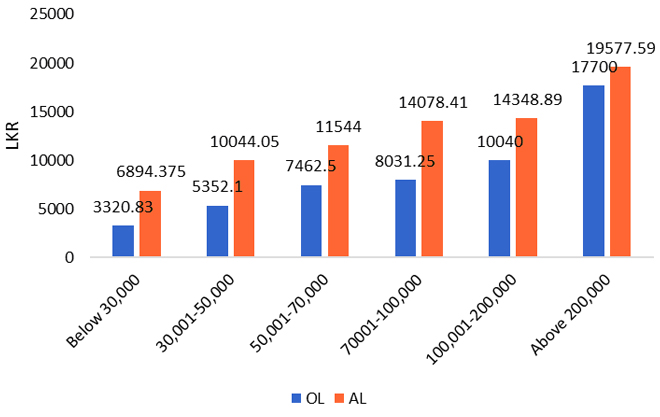
have been unbearable for parents of school-going children. The IPS study found that students who
belonged to family income levels below LKR 30,000 spend approximately LKR
3,000-Rs. 7,000 per month while students whose family income was above LKR 200,000
spend approximately LKR 18,000- LKR 20,000 per month on private tuition
depending on the grade of the student. This scenario is illustrated in Figure 1.
Figure 1: Monthly Tuition Expenditure by Monthly Household Income
Source:
Institute of Policy Studies of Sri Lanka, 2021.
Further,
most O/L and A/L level students spend more than LKR 2,000 per month on data
packages for both school and tuition online classes, while most students who
spend more than LKR 2,000 per month are concentrated among the higher family
income categories. If LKR 2,000 is spent on monthly data packages, it would
approximately account for 1% of whose family income is above LKR 200,000, and
more than 7% of whose family income is below LKR 30,000. All this highlights
the perceived importance of private education, especially among O/L and A/L
grades, and the financial burden it imposes on a family’s household income.
These
affordability concerns were partly offset by the introduction of free online
classes during the pandemic, which has provided considerable relief for
financially vulnerable students according to students interviewed for the IPS
study. Affordability concerns were further allayed by reduced class fees by
some tutors. The fee reductions were made by accounting for the structural changes
of administrative and operating costs of an online setting applicable based on
the scale and intensity of operations of tutors. Financial issues faced by the
families experiencing household income losses during the pandemic were also
considered in fees reduction.
Accessibility
to Online Classes
Online platforms
were the sole medium for conducting classes during the pandemic while it becomes
an option in the current context considering the social unrest, curfews and
travel constraints due to fuel shortages. However, many students faced
accessibility issues in joining online classes. The issues faced were poor
signal coverage, high data costs, lack of necessary devices, and affordability
concerns in the context of lost household income during the pandemic. Most of
the students who belonged to a family income level above LKR 200,000 used a
laptop/tablet while most of the students who belonged to a family income level
below LKR 30,000 relied on a smartphone. Smartphones were found to be less user
friendly for academic pursuits. In addition to the above issues, the ongoing
power outages also present impediments to online education.
The
accessibility issues are mainly experienced by students from families with
comparatively lower income levels, and those who had to rely on a smartphone
for academic purposes. This implies a close positive relationship between
household income and the quality of the education received; financial strength being
the primary determinant of accessibility.
However,
these accessibility issues were partly offset by the divergent opportunities
experienced by students, especially in the context of online platforms. These
prospects included the ability to join online classes conducted in distant
locations that would otherwise have been restricted due to travel constraints
and increased time available due to school closures. As a result, they
increased the duration of tuition classes using the saved travel time.
Way
Forward
While
private tutoring became a way of bridging the gaps in the education system
during the crisis, learning losses for the most vulnerable groups have further
widened with accessibility and affordability issues. Since these issues were
mainly observed among O/L and
A/L student groups, there is a higher risk that vulnerable student groups would
be highly challenged during their most decisive years leading to higher
education and career development. Thus, it is necessary to address the affordability
issues, focusing more on the vulnerable student groups. Financial assistance
could be provided in terms of a certain number of free hours of teaching for
selected financially vulnerable students and allocating a selected proportion
of students to be taught at a concessionary rate.
To address the accessibility issues, recording the lessons and distributing the notes on different platforms will help to a certain extent. Providing digital equipment and networks for selected tuition centres and schools could also be considered since the lack of facilities and resources were identified as major accessibility issues for distance education. These would require collaborative efforts among the government, tutors, parents, non-government organisations and any other well-wishers.
Usha is a Research Assistant working on health, labour and education policy at IPS. She holds a BA in Economics with First Class Honours from the University of Colombo. During her undergraduate studies, Usha won the award for ‘Best Performance’ at both the second year examination and final degree examination from the Department of Economics, University of Colombo. She is also a CIMA Passed Finalist. She is currently reading for a Master’s Degree in Economics at the University of Colombo. (Talk with Usha: usha@ips.lk)