

Has Sri Lanka’s Crisis-driven Import Controls Incentivised Import Substitution?
By Dr Asanka Wijesinghe and Nilupulee Rathnayake:
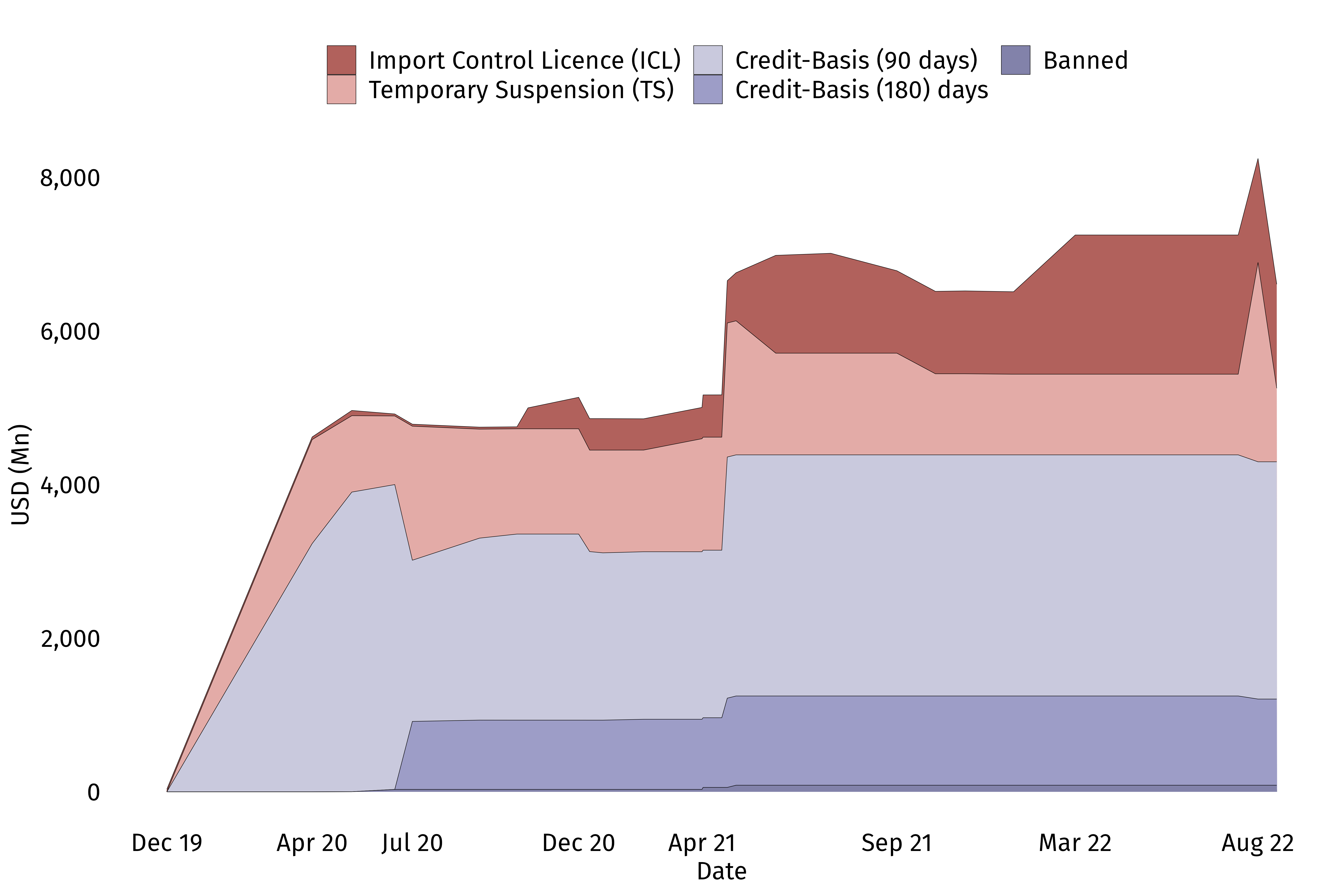
In response to the economic crisis, Sri Lanka implemented import controls that expanded significantly by the end of 2022, accounting for approximately 30% of the country’s total import value (Figure 1). The controls affected various categories, including consumption goods (46%), intermediate goods (31%), and capital goods (24%). As Sri Lanka gradually eases these controls, questions arise about the necessity of this strategy and its impact on economic growth.
| Industries with Highest Protection Levels by Import Value | Industries with Lowest Protection Levels by Import Value | |||
| Industry | Protection Coverage | Industry | Protection Coverage | |
| Communication equipment | 100.0 | Manufacture of knitted and crocheted fabrics | 0.0 | |
| Electric motors, generators, transformers and electricity distribution apparatus | 91.4 | Weaving of textiles | 0.0 | |
| Dairy products | 90.0 | Manufacture of other textiles | 0.0 | |
| Manufacture of basic precious and other non-ferrous metals | 90.0 | Manufacture of pulp, paper and paperboard | 0.1 | |
| Manufacture of pharmaceuticals, medicinal chemical and botanical products | 89.1 | Extraction of crude petroleum | 0.2 |
Source: Authors’ calculation
Recommendations for Prioritising Import Control Revisions
As Sri Lanka gradually eases the import controls implemented during the economic crisis, it becomes crucial to prioritise the revision process. The deciding factors may be influenced by lobbying from industries reliant on restricted imports and feedback from industry and consumers. Our analysis suggests that revisions appear to prioritise intermediate and exempted food products, reflecting a policy preference for exempting intermediate imports (Figure 2).
Figure 2: Variation in the Likelihood of a Product being Removed from Import Controls during Revisions
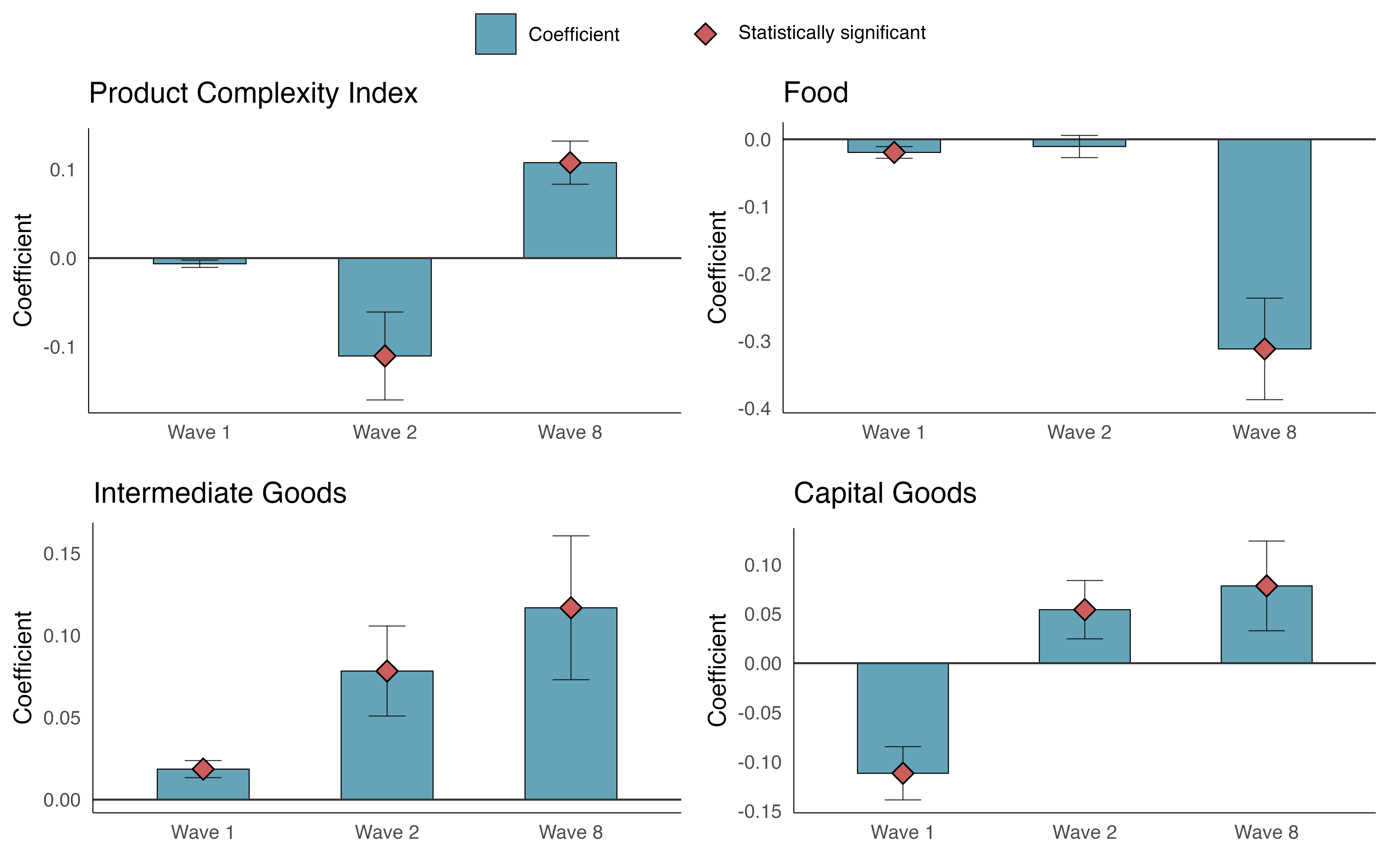
Notes: Intermediate products were more likely to be removed from import controls in each wave, while consumption goods were less likely to be deleted. Food products were less likely to be removed from import controls than non-food items.
Source: Authors’ estimates
To foster innovation and enable participation in global value chains, it is economically sensible to phase out import controls on intermediate goods. However, revisions should also target consumption goods, including food. Import controls inflate domestic prices, leading to the production of less complex consumer goods and food items for domestic consumption. This diverts resources away from export industries, impeding the country’s growth in the vital export sector.
Revisiting import controls on food products is particularly important due to their impact on urban and suburban households. These controls exacerbate food costs and shortages, burdening households, especially those with low incomes. More damagingly though, the distortion in incentives (the import-substitution incentive structure) perpetuates labour movement and retention in the agriculture sector.
More details on this study can be found in Wijesinghe, A., Yogarajah C., and Rathnayake N., (forthcoming) “Import Controls in Sri Lanka: Political Preference and Incentive Distortions”, International Economic Series, Institute of Policy Studies of Sri Lanka. Colombo.

Asanka Wijesinghe is a Research Fellow at IPS with research interests in macroeconomic policy, international trade, labour and health economics. He holds a BSc in Agricultural Technology and Management from the University of Peradeniya, an MS in Agribusiness and Applied Economics from North Dakota State University, and an MS and PhD in Agricultural, Environmental and Development Economics from The Ohio State University. (Talk with Asanka – asanka@ips.lk)

Nilupulee Rathnayake is a Research Assistant working on Macro, Trade and Competitiveness research at IPS. She holds an MSc in Development Economics from the University of Nottingham, United Kingdom, and a BA in Economics from the University of Colombo, Sri Lanka. (Talk with Nilupulee – nilupulee@ips.lk)