
Public Investment for SDG Financing in Sri Lanka: Reality or Myth?
By Dr Lakmini Fernando
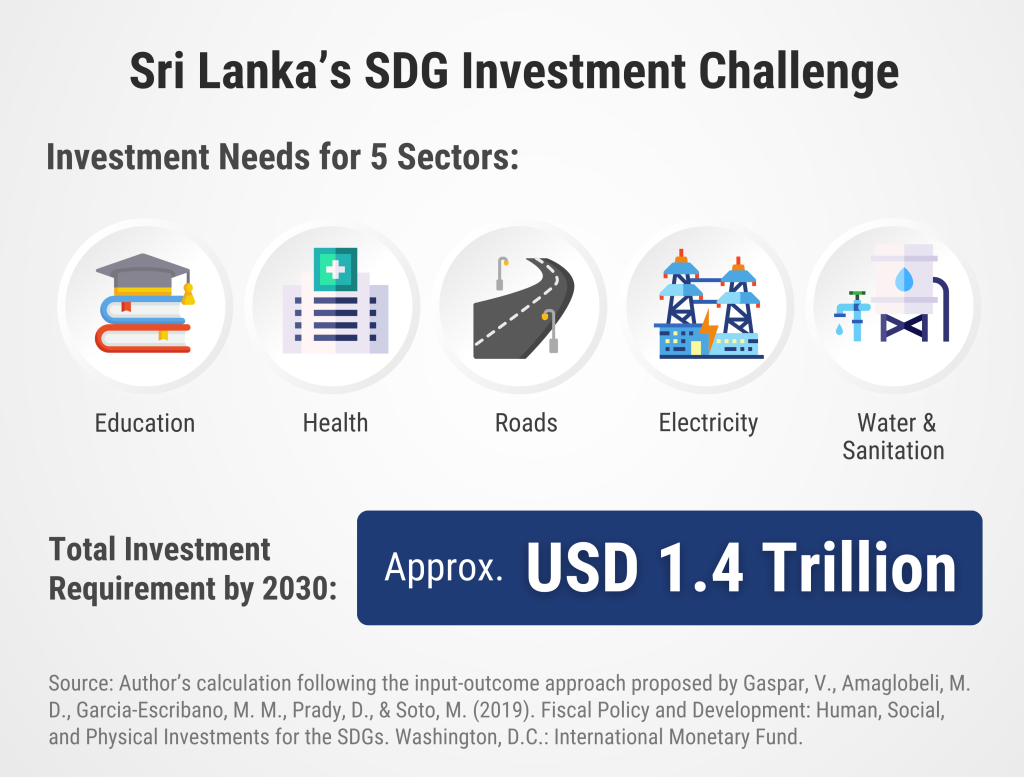
Realising Sustainable Development Goals (SDGs) by 2030 requires substantial investment allocation, especially for developing economies like Sri Lanka. A recent IPS study found that Sri Lanka needs an additional investment of USD 1.4 trillion or 12.5 percentage points of GDP by 2030 to achieve SDGs. Despite Budget 2024 allocating 5.4% of GDP for public investment, concerns arise due to the historical average of 3.4% of GDP during 2022-2023.
SDG Financing Challenges
Debt repayment commitments, widening primary deficits and poor domestic resource mobilisation will collectively make development financing a daunting task. Scantiness in SDG financing is not unique to Sri Lanka. Despite its undeniable importance, SDGs have never received adequate financial support on a global basis.
Fiscal policy is said to be more influential in advanced economies where public investment and tax revenue increase with per-capita incomes. However, the role played by public investment in developing economies cannot be overlooked, as it stimulates economic activity and attracts private investments to the country.
In overcoming the SDG financing gap, Sri Lanka could look for non-debt creating alternative financing mechanisms like blended financing, international tax reforms, globally earmarked taxes, increased official development assistance and giving pledges. As governance quality positively correlates with investment inflow, attempts to improve governance by combatting corruption and increasing transparency would enhance Sri Lanka’s eligibility to receive these funds.
Sri Lanka Needs ‘Positive Changes’
Capturing Socio-Economic Underdevelopments: In general, the advanced economies are closer to achieving SDGs than any other country group. According to the SDG index that measures the overall SDG performance, Sri Lanka recorded an above-world average score of 0.72 and 0.16 before and after the pandemic. Considering the severity of multiple crises, this progress creates much ambiguity on the sensitivity of SDG monitoring and reporting mechanisms. If we are to capture true development challenges, the existing systems might need serious modifications.