
Sri Lanka Must Secure Its Electricity, Water, AI, Cloud & Digital Lifelines in 21st Century Before Next Failure Trouble Entire Nation
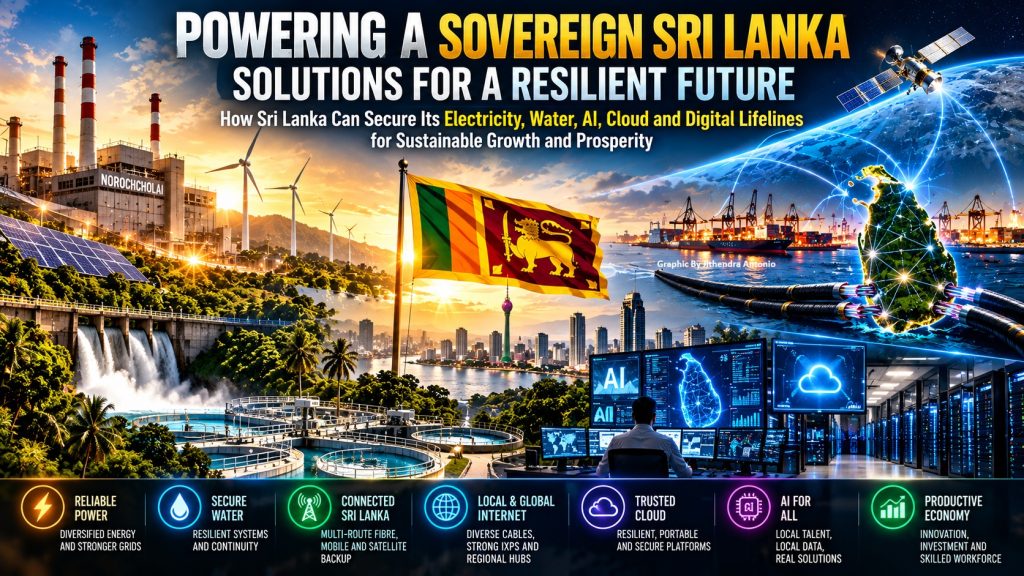
By Jithendra Antonio
Sri Lanka’s greatest strategic vulnerability in the artificial intelligence age may not be a shortage of algorithms, foreign investment or technological ambition. It may be the inability to keep the country functioning when electricity disappears, water pumps stop, telecommunications weaken and essential digital services become inaccessible.
The nationwide electricity collapse on 17 October 2026 delivered an unmistakable warning. A disturbance in the transmission network triggered a countrywide outage, while the National Water Supply and Drainage Board warned that water operations could be disrupted. Reports subsequently confirmed that the Ambatale and Biyagama treatment plants temporarily halted purification operations. The National System Operator launched an investigation into the failure according to news reports.
This was not merely an electricity problem. It was a demonstration of how the failure of one critical system can spread into another.
The lesson is uncomfortable but unavoidable. A country cannot claim operational sovereignty if its essential services depend on infrastructure that cannot withstand foreseeable disruptions.
When the electricity fails, the state begins to feel the consequences
Electricity is the foundation beneath hospitals, water treatment, telecommunications, banking, transport, manufacturing, government administration and national security. When that foundation weakens, the consequences travel far beyond the power bill.
Sri Lanka’s Norochcholai coal-fired power station has approximately 900 megawatts of installed capacity. Following the October blackout, the National System Operator reported that the plant had been shut down under standard procedures. Subsequent reporting indicated that approximately 810 MW would remain unavailable for several days. The distinction matters – the blackout involved a national grid failure, and the available reporting does not establish that Norochcholai alone caused it according to available reports.
Yet the strategic question remains. What happens when a major generator becomes unavailable, transmission stability deteriorates and replacement capacity cannot be deployed quickly enough?
A modern electricity system must withstand individual equipment failures without collapsing nationwide. It needs sufficient reserves, dependable generation, properly protected transmission networks, automatic protection systems, black-start capability and rehearsed restoration procedures.
Sri Lanka must publish an independently reviewed technical investigation into the October event, explain the sequence of failures and establish measurable corrective actions. Public accountability should not mean publishing sensitive operational details that could help attackers. It should mean explaining what failed, why existing safeguards were insufficient and what will change.
Water security is National Security
The relationship between electricity and water is immediate. Treatment plants require power. Pumps require power. Distribution systems depend on functioning equipment, pressure management and communications. A blackout can therefore turn an electricity disruption into a water emergency.
That vulnerability deserves special attention because Sri Lanka already understands the strategic significance of controlling water infrastructure.
In July 2006, the closure of the Mavil Aru sluice gates disrupted water supplies to communities and agricultural land in the Eastern Province. The confrontation became a major turning point in the conflict between the government and the LTTE. The episode demonstrated how control over an essential resource could acquire consequences far beyond irrigation and drinking water.
The comparison must be made carefully. A technical power failure is not equivalent to an armed group deliberately restricting a waterway. The enduring lesson, however, is that the authority and capability to maintain essential supplies cannot be treated as peripheral responsibilities.
Sri Lanka needs resilient water infrastructure with independent backup power, emergency generators, battery-supported control systems, protected fuel supplies, alternative pumping arrangements and sufficient treated-water storage. Critical treatment facilities should be able to operate through prolonged grid interruptions, with realistic fuel replenishment plans and regular load testing.
Every major urban water system should have a documented continuity plan. Authorities must know which hospitals, densely populated communities and essential facilities receive priority during an emergency, while protecting equitable access and preventing politically motivated discrimination.
The objective is straightforward. No household should discover that its water supply depends entirely on a power network that has no credible fallback.
Sovereignty means Capability, not a Government Monopoly
Whatever political party governs Sri Lanka, the state must retain the legal authority, technical competence and practical capacity to safeguard essential national functions.
That does not mean nationalising every electricity company, telecommunications operator, cloud platform or technology provider. Nor does it mean isolating Sri Lanka from global markets.
Sovereignty means having genuine alternatives.
A government that relies on a single supplier without an exit plan has surrendered bargaining power. A country that stores data locally but cannot access it when an overseas cloud service fails has achieved data residency, not operational independence. A telecommunications network that belongs to a domestic company but depends on one vulnerable fibre route remains exposed.
The state must set resilience standards, enforce competition, oversee emergency arrangements and ensure that private operators serving critical sectors can demonstrate continuity. Ownership is secondary to the ability to keep services functioning.
National sovereignty must survive elections, cabinet changes, commercial disputes and geopolitical pressure.
The Cloud is not the Country
Artificial intelligence is rapidly becoming infrastructure rather than a novelty. Governments, banks, hospitals, ports, schools and businesses increasingly depend on cloud computing, software platforms, digital identity, automated analysis and remotely hosted applications.
Sri Lanka should use international cloud providers wherever they offer competitive, secure and efficient services. But essential national functions cannot be designed around the assumption that every foreign platform, international connection and software update will remain available.
Consider a national tax system hosted in one cloud environment. A prolonged outage compromised administrator account, contractual dispute or connectivity failure could make the service unavailable even if the underlying information remains intact.
The remedy is a layered architecture.
Sensitive government records should have clear access controls, encryption, independently managed recovery credentials where appropriate, tested backups and defined legal protections. Essential workloads should be portable between compatible environments. Critical public services need alternative hosting and local processing capacity sufficient to maintain priority operations during an external interruption.
Sri Lanka does not need to build a domestic equivalent of every global hyperscale platform. It needs a strategically designed national compute capability, shared by universities, researchers, startups and essential public services, with commercial providers competing to deliver additional capacity.
Artificial intelligence must also work in Sinhala and Tamil, reflect local conditions and support public needs. A national AI programme without reliable electricity, trained engineers, quality datasets and real users would be an expensive symbol rather than a productive asset.
Undersea Cables, Satellites and the Price of Disconnection
International connectivity is another critical dependency. The International Telecommunication Union identifies submarine cables as carrying more than 99% of international data traffic. Sri Lanka’s position on major East–West routes creates opportunities, but geographic advantage alone does not guarantee resilience.
Sri Lanka Telecom’s 2025 reporting identifies SEA-ME-WE 4, SEA-ME-WE 5, the Bharat Lanka connection and the Dhiraagu–SLT link among its international connectivity assets. SEA-ME-WE 6 was scheduled for commissioning in the first quarter of 2027. These systems provide a foundation, but resilience depends on genuinely independent routes, available capacity and tested failover—not simply counting cables.
A cable cut could increase latency, interrupt services or force traffic onto constrained alternatives. If essential government platforms, financial systems or cloud applications cannot operate without one international route, Sri Lanka inherits a strategic weakness.
The government should commission a confidential national connectivity risk assessment, strengthen terrestrial fibre alternatives and support diverse cable landing arrangements. Satellite communications should provide emergency connectivity for disaster management, hospitals, security agencies and other designated critical users.
Satellites cannot economically replace submarine cables for most high-volume international traffic. They can, however, provide a vital fallback when terrestrial links fail.
Sri Lanka should also strengthen local internet exchange capacity, routing security and domestic hosting. The objective is to remain connected to the world while ensuring that a single external disruption cannot disable essential national operations.
From Hollywood’s Die Hard 4.0 to Zero Day – Fiction as an Early Lesson to Train
In Live Free or Die Hard, also known as Die Hard 4.0, cyberterrorists target interconnected infrastructure, demonstrating how dependence on digital control systems can magnify disruption. Netflix’s 2025 limited series Zero Day depicts a devastating cyberattack, institutional confusion and the operation of information during a national crisis. Both are fictional works, not evidence that an equivalent coordinated attack has occurred or would unfold exactly as portrayed.
Their relevance lies in the questions they force policymakers to confront.
What if an electricity disruption coincided with a telecommunications failure? What if hospital scheduling, payment systems and public communications became unavailable during a disaster? What if false information circulated faster than official warnings?
These are continuity-planning questions, not predictions of an imminent catastrophe.
Sri Lanka must secure operational technology controlling power, water and transport separately from ordinary office networks. Operators need tested offline procedures, protected administrative access, independent backups, incident-response teams and exercises involving multiple agencies. AI systems themselves must be governed carefully because automated decisions can amplify errors, operated information and compromised data.
The objective is not to frighten the public. It is to ensure that foreseeable failures do not become national emergencies.
A Practical Sovereignty Programme for Sri Lanka
Within 12 months, the government should complete a national audit of critical dependencies covering electricity, water, telecommunications, submarine cables, cloud platforms, data centres, fuel, emergency communications and essential public databases. The October blackout investigation should produce an action plan with named institutional responsibilities and public progress reporting.
Within 24 months, critical water and telecommunications facilities should demonstrate tested backup power and communications. Electricity planners should publish resilience indicators, including restoration performance, reserve adequacy and progress on correcting identified grid weaknesses. Essential government services should maintain verified backups and documented recovery procedures.
Within three to five years, Sri Lanka should expand renewable generation alongside storage, strengthen transmission and distribution, improve demand management and diversify essential connectivity. Shared national AI compute should expand only where electricity, cooling, cybersecurity, skills and credible demand justify investment.
Within five to ten years, Sri Lanka should develop exportable capabilities in AI applications, cybersecurity, financial technology, agricultural intelligence, digital public services and regional infrastructure support. Universities and industry should train the engineers, grid technicians, security specialists and AI developers required to operate these systems.
Financing should combine carefully structured public investment, competitive private capital, infrastructure finance and transparent public-private partnerships. Contracts must allocate risk clearly, prevent monopolistic lock-in and establish measurable performance obligations.
A national resilience dashboard should track outage duration, water-service continuity, cable diversity, recovery times, cloud portability, cyber incident response, rural connectivity and the cost of reliable service. Progress must be measured by actual performance rather than announcements.
Towards a Digitally Secured Sovereignty
Sri Lanka cannot afford to confuse digital ambition with digital sovereignty.
A new AI centre is not strategic independence if its electricity supply is fragile. A domestic cloud is not resilience if its administrators, backups or network connections create single points of failure. A second submarine cable is not redundancy if both routes share the same vulnerable corridor.
The state’s responsibility is to ensure that essential systems remain available regardless of who occupies political office, which company provides the service or what external crisis unfolds.
The October blackout exposed a problem that technology policy alone cannot solve. Sri Lanka needs an integrated national strategy connecting energy, water, communications, AI, cybersecurity, emergency management and public accountability.
Mavil Aru demonstrated the strategic importance of water. The latest blackout demonstrated how electricity failure can disrupt water operations. The next crisis may involve a cable, a cloud provider, a compromised control system or several failures occurring together.
The question is not whether Sri Lanka should embrace global technology. It must. The question is whether the country will enter the AI age as a capable partner with credible alternatives—or remain dependent on systems it cannot reliably sustain.
Sovereignty in the twenty-first century is the ability to keep the nation powered, watered, connected and governed when the systems around it fail. Sri Lanka must build that capability before the next warning becomes a catastrophe.

(The writer is a Consultant specialised in Data Analytics with a Special Focus on Sri Lanka’s Future Direction, and in the fields of Sustainable Energy, ESG, Investments and telecommunications. He can be reached at jithendra.antonio@gmail.com.)