
Preparing Sri Lankan Stakeholders for the New EU Packaging and Packaging Waste Regulation
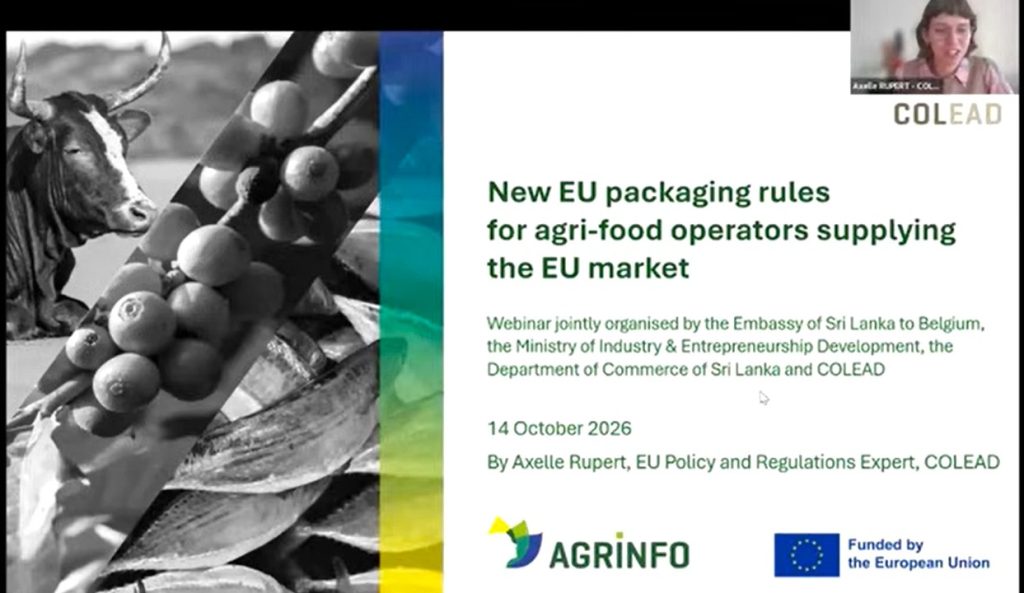
On 14 October 2026, the Embassy of Sri Lanka in Belgium, in collaboration with the Department of Commerce, the Ministry of Industry and Entrepreneurship Development of Sri Lanka, and the EU-funded AGRINFO programme implemented by the Committee Linking Entrepreneurship, Agriculture and Development (COLEAD), organised an educational webinar to strengthen the preparedness of Sri Lankan public and private sector stakeholders for the new EU Packaging and Packaging Waste Regulation (PPWR) and discuss its implications for Sri Lankan exports to the European market. More than 200 Sri Lankan export companies participated in the webinar.
The webinar commenced with introductory remarks by the Director General of Commerce, Somasena Mahadiulwewa; the Additional Secretary of the Sectoral Development Division at the Ministry of Industry and Entrepreneurship Development, S.W.C. Jayamini; and the Minister (Commercial) at the Embassy of Sri Lanka, Thavishya Mullegamgoda. The speakers highlighted the importance of keeping Sri Lankan exporters informed of evolving EU regulatory requirements and strengthening their preparedness to maintain access to the EU market.
The technical session was conducted by the EU Policy and Regulations Expert at COLEAD, Axelle Rupert, who provided an overview of the new regulatory requirements. The discussion focused on the EU PPWR (EU) 2025/40, which introduced requirements relating to packaging design, composition, waste prevention and management. The session also addressed provisions concerning per- and polyfluoroalkyl substances (PFAS) and EU Regulation 2024/3190 on the use of bisphenol A (BPA) and other hazardous bisphenols in certain food-contact materials.
The PPWR generally applies from 12 August 2026, with specific provisions subject to separate timelines and transitional arrangements. The regulation aims to reduce packaging waste, promote recyclable and reusable packaging, and encourage a more circular economy. Its requirements have significant implications for Sri Lankan exporters, particularly in the tea, spices, seafood, processed food, beverage and fast-moving consumer goods (FMCG) sectors, as well as local packaging manufacturers serving export-oriented industries.
Participants were briefed on the importance of understanding the new requirements, identifying potential compliance challenges and taking appropriate measures to prepare their products and packaging for the EU market. The webinar also highlighted the importance of staying informed about regulatory developments and strengthening cooperation among public institutions, industry stakeholders and exporters to facilitate continued access to the European market.
The webinar emphasized that the transition should be viewed not only as a compliance challenge but also as an opportunity. Investing in sustainable packaging, improving resource efficiency and exploring innovative materials and designs could help Sri Lankan businesses strengthen commercial relationships with European partners and enhance their competitiveness in increasingly sustainability-conscious markets.
The session concluded with an interactive question-and-answer segment, providing participants with an opportunity to seek clarification on the new requirements and their practical application to Sri Lankan exports.
Moderating the webinar, the Director of Commerce and Head of Trade Promotion and Bilateral (West) at the Department of Commerce, Charitha Yattogoda, stated that the webinar would contribute to a better understanding of the new EU packaging requirements and help Sri Lankan businesses take timely measures to remain competitive in the European market.
The initiative reflected the continued efforts of Sri Lankan institutions to support the country’s export sector by facilitating access to timely information on EU market requirements.