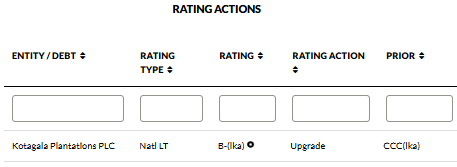
Fitch Upgrades Kotagala Plantations to ‘B-(lka)’; Outlook Stable
Fitch Ratings has upgraded Kotagala Plantations PLC’s National Long-Term Rating to ‘B-(lka)’, from ‘CCC(lka) and assigned a Stable Outlook.
The upgrade factors in improving liquidity as Kotagala accessed new bank financing in the financial year ended March 2026 (FY26), and continued to deleverage by repaying debt. However, the company continues to face refinancing risk because it does not have unutilised credit facilities while its ability to meet debt obligations with internal cash generation remains limited.
The rating also reflects the company’s exposure to commodity price volatility and operating cost pressures following recent regulatory increases to wages of plantation workers.
Key Rating Drivers
Liquidity Weak but Improving: Kotagala obtained new working-capital financing from banks in FY26 and completed a rights issue, with part of the proceeds used to settle debt. Improved banking access and lower debt support better liquidity. However, Kotagala continues to rely on higher-cost working-capital financing from brokers. Kotagala remains exposed to refinancing risk, as it has no unutilised credit facilities and limited capacity to meet debt obligations through internally generated cash.
Cash and equivalents of LKR109 million were insufficient to cover LKR576 million of short-term debt at end-1QFY27. We expect annual free cash flow (FCF) to fall to around LKR100 million in FY27 and FY28, significantly below the LKR270 million average in FY24-FY25, due to pressure on operating costs. FCF turned negative in FY26, driven by working-capital outflows and higher capex.
Lower Debt and Leverage: Total debt was stable at LKR1 billion in 1QFY27 (FY26: LKR1 billion; FY25: LKR1.6 billion), while EBITDA net leverage rose slightly to 1.8x (FY26: 1.5x). We include related-party payables of LKR184 million in 1QFY27 (FY26: LKR 215 million) in our calculation of total debt.
Kotagala fully repaid loans from domestic banks in FY26, partly through the proceeds of the rights issue. In addition, the company fully settled its outstanding debentures during 2QFY27. Net leverage is significantly lower than the 3.2x in FY24 and we expect leverage to remain below 2.0x under our rating case over the next two years.
No Uplift for Parental Support: The corporate guarantee from Kotagala’s immediate parent leads to our ‘Medium’ assessment of the legal incentive for the ultimate parent, The Colombo Fort Land & Building PLC (CFLB), to provide support to Kotagala and could result in a one-notch rating uplift. However, we applied an analytical overlay to exclude this uplift, given the limited visibility of receiving timely support to avoid future payment defaults or debt restructuring.
Parent’s Weak Support Incentives: We also assess the operational and strategic incentives for CFLB to support Kotagala as ‘Weak’. This is because the subsidiary contributes less than 10% to CFLB’s EBITDA. In addition, Kotagala’s tea and rubber plantations, which drive most of its revenue, are structurally weakening amid Sri Lanka’s high production costs and there is low avoidance cost of the subsidiary’s operational benefits to the parent.
Volatile Demand and Prices: Most Sri Lankan tea producers are price takers that are unable to pass on production cost increases. About 45% of tea is exported in bulk, without value added. This also raises the risk of substitution. Tea auction prices have fluctuated in recent years, even though Sri Lanka’s tea attracts better prices due to its quality. Exports are mainly to politically and economically volatile regions, like parts of the Middle East and Russia.
Narrowing EBITDA Margin: We forecast EBITDA margin to remain around 10% over FY27-FY28 (FY25: 18%, FY26: 11%) amid structural industry weaknesses, including a 15% increase in plantation companies’ wage costs from January 2026, after factoring in government support. While the wage rise has been absorbed into prices, the margin will also be squeezed by depressed plantation yields due to labour shortages and ageing crops. Replanting costs are also rising. Sri Lanka has the lowest productivity and the highest cost among major tea producing countries.
Peer Analysis
Kotagala’s rating reflects weak liquidity stemming from its limited funding access, and volatile operating cash flow due to margin pressure in its tea and rubber plantation businesses. These factors result in Kotagala being rated multiple notches below other publicly rated non-financial corporates in Sri Lanka.
Fitch’s Key Rating-Case Assumptions
Revenue to decline by 5.5% in FY27 as the Middle East conflict depresses tea exports. Revenue to increase by low single digits from FY28 as auction price growth is moderated by falling yields.
EBITDA margin to decline to 9.5% in FY27 (FY26: 10.8%), due to the impact on sales volumes and higher operating expenses including wages
Capex of around LKR250 million annually in line with historical levels
No dividend payments over FY27-FY28
RATING SENSITIVITIES
Factors that Could, Individually or Collectively, Lead to Negative Rating Action/Downgrade:
A weakening in liquidity or funding access
Factors that Could, Individually or Collectively, Lead to Positive Rating Action/Upgrade:
A sustained improvement in liquidity and funding access
Evidence of support from the parent company CFLB
Liquidity and Debt Structure
Kotagala had LKR576 million of short-term debt at end-June 2026, compared to LKR109 million of readily available cash. While the company has been able to obtain new borrowings from banks, it has also recently settled working-capital borrowings with equity and continues to obtain higher-cost broker credit for working-capital purposes. Kotagala did not have access to unutilised credit facilities as of September 2026 and plans to repay debt with proceeds from a legal dispute over one of its estates. Therefore, the liquidity profile remains weak despite some improvement.
Issuer Profile
Kotagala is a Sri Lankan plantation company engaged in the cultivation and sale of tea, rubber and palm oil.
REFERENCES FOR SUBSTANTIALLY MATERIAL SOURCE CITED AS KEY DRIVER OF RATING
The principal sources of information used in the analysis are described in the Applicable Criteria.
MACROECONOMIC ASSUMPTIONS AND SECTOR FORECASTS
Click here to access Fitch’s latest quarterly Global Corporates Sector Forecasts Monitor data file which aggregates key data points used in our credit analysis. Fitch’s macroeconomic forecasts, commodity price assumptions, default rate forecasts, sector key performance indicators and sector-level forecasts are among the data items included.