COVID-19: out of chaos comes opportunity. But opportunity must be seized to become reality.
By Jekhan Aruliah
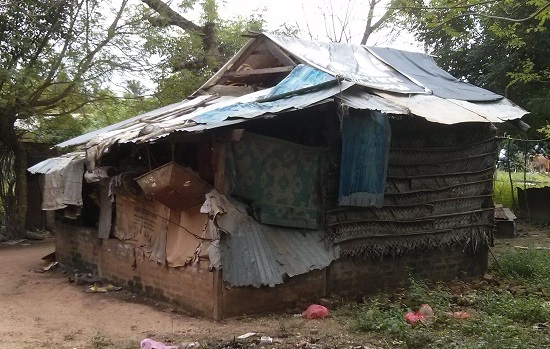
Tinned fish to tin houses: in the weeks of the 2020 Corona curfews we frequently saw on television and on Facebook fish in metal tins donated to families in metal huts. The Covid-19 Crisis shone a stark light on the large segment of our population in Sri Lanka living in chronic dire poverty. People living hand to mouth relying on a day’s wage for a day’s living. We have seen mothers of all religions and ethnicities across our land from North to South in tears, terrified their children will go without food.
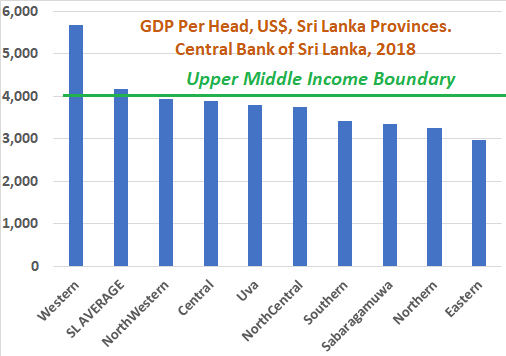
In the midst of this miserable trauma, at the end of April 2020, the Central Bank of Sri Lanka (CBSL) released its latest annual report for 2019 declaring we have been promoted by the World Bank to “Upper-Middle Income Country” status.
CBSL data reveals Sri Lanka is two nations. The Western Province comfortably “upper middle income” while the rest, in particular the Northern; Southern; Eastern and Sabaragamuwa, marooned in the “lower middle” bracket.
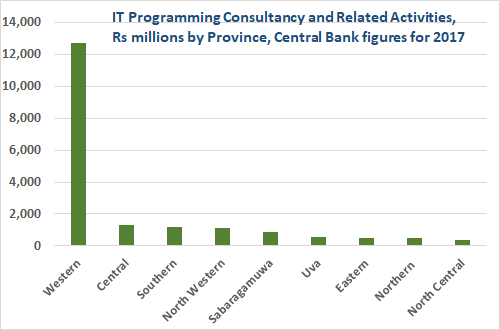
Other data also emphasise that prosperity and opportunity has failed to spread across Sri Lanka. For example, our IT industry is heavily entrenched in the Western Province. This graph, using CBSL data published in 2019, shows the GDP contribution of “IT Programming, Consultancy and Related Activities” from each province for 2017 :
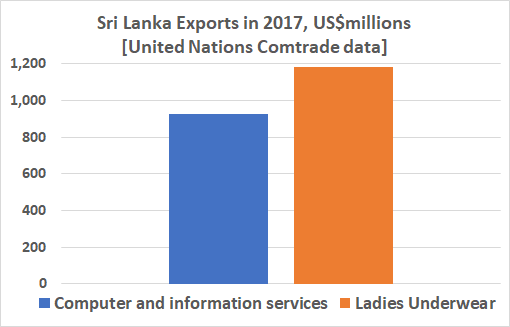
Data supplied by the Government of Sri Lanka to the United Nations (UN) International Trade Statistics Database, a.k.a. UN Comtrade, on national Exports and Imports shows in 2017 (the latest figures available at the time of writing this article) we exported more ladies underwear and nighties than we did computer and information services. To be clear, that is knickers, nighties, bras and other more intimate wear alone. Which itself is only a small fraction of all the garments we export.
According to this UN Comtrade data, most easily viewed on a Harvard University visualization you can see by clicking these links for India and for Sri Lanka, in 2017 ICT made up nearly 27% of India’s exports but just 5.44% for Sri Lanka.
Our ICT industry should leap at the opportunity to grow beyond the Western Province in order to get past the ladies underwear. For Sri Lanka’s main ICT/BPM industry body, SLASSCOM, to achieve its heroic target of going from close to US$1 billion in 2017 to US$5 billion export revenue by 2022 , even adjusted down for the economic impact of COVID-19, it needs to!
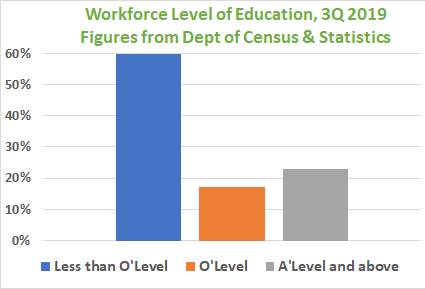
We claim to have a highly educated workforce. However according to the Dept of Census & Statistics nearly 60% of our workforce do not even have O’Levels. Compulsory education in Sri Lanka is only up to Grade 9, before O’Levels are taken in Grade 11. In Sri Lanka there are children who are taken out of school asap to work so their poverty stricken families can eat. Paying these children’s families to keep them in school for Grade 10 and Grade 11 would be a direct investment lifting our workforce’s level of education.
Sri Lanka boasts over 93% literacy, but the UN’s test is “A person is literate who can with understanding both read and write a short simple statement related to his/her everyday life”. This test is applied to over 15 year olds, who presumably would be classed “literate” if they can in their native language:
1) Write and Read: “My name is John, and I have a red bicycle” So, is there any good news from the COVID-19 Crisis?
The Good News
From fact to fiction, Crises = Opportunity.
Baron Rothschild, a banker who made a fortune funding the British during their
war against Napoleon, advised “Buy when there’s blood in the streets,
even if the blood is your own”. Petyr “Littlefinger” Baelish, a fictional
character in the Game Of Thrones drama, said “Chaos isn’t a pit. Chaos is
a ladder”. Of course, a ladder still has to be climbed.
The Covid-19 chaos has created a ladder for those who would
climb it. Already we see some of the rich and powerful around the world scrambling
up. But it is also a ladder for the poor and neglected.
One of these opportunities is providing and delivering goods and services remotely: from food to education to simply doing your day job. This is a ladder for those in Sri Lanka’s remote, neglected and under-resourced regions. Which means everywhere outside the Western Province and North Western Province.
Education:
Even the world’s great universities are operating at a distance because of COVID-19. Cambridge University announced in March 2020 “The University has decided that students should not return physically for Easter Term, and that all teaching for next term will be done online”. Schools during the lengthy school closures across the UK routinely conducted classes over the internet. Teaching methods and materials for distance learning are being developed across the locked-down World, in many languages, and at all levels from primary school toddlers to Cambridge University undergraduates.
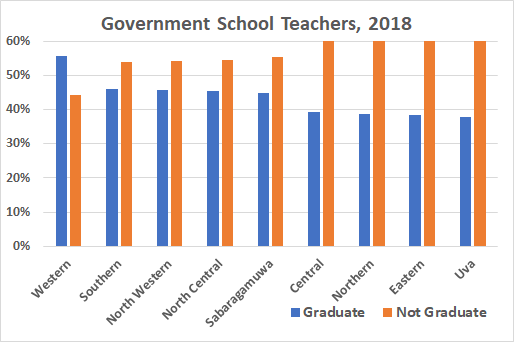
The educational attainment of schools, particularly in Sri Lanka’s remote and rural areas, has been poor. Reasons for this are many, including the lack of qualified teachers particularly in maths, sciences and English. One way or another, graduate teachers find ways to avoid posting to certain more difficult areas, as can be seen from this data from the CBSL.
The highest powered tuition masters and mistresses
concentrated in the prosperous towns and cities and also those who live overseas
can reach out to our students in remote areas via ZOOM or WhatsApp. Not only to
provide their services, but to put an upward competitive pressure on other local
tutors. Their services need to be paid for, perhaps by the government or by a
charitable fund. Though the tuition industry in Sri Lanka is much criticized,
if you are going to spend your money and inflict this on your children you may
as well get a good tutor.
High Value Industry:
Probably the most high profile high value industry in Sri
Lanka nowadays is Information Technology (IT). From the point of view of a child
approaching the end of their school career, it is a route into a well paid,
clean, safe, airconditioned office job, with opportunities to move overseas,
without having to spend years getting statutory professional qualifications. The
high value IT industry is overwhelmingly in the Western Province. Due to the
COVID-19 Crisis, companies where staff work from a desk have been forced to
allow people to work from home, or to shut them down.
The technological challenge of sitting at home tapping at
your computer is FAR less than the human challenge of managing teams and
keeping them working as cohesive units turning out quality products and
services on tight schedules. These challenges are being overcome by our better
companies, the best of whom can extrapolate this to employ staff in our more remote
areas.
Companies that can succeed with distance working, reducing
the cost of office space and employing staff who don’t have the personal cost
of paying sky high rents and wasting time and money on the Colombo commute can
thrive. Not least because the kind of management who can make this succeed has
the DNA to make other unrelated innovations succeed. This is a management
problem, not a technical problem.
Food and Drink:
When the curfew was lifted in Colombo for one day in the
middle of March, the hours long queues ending at empty shelves convinced many to
resort to home deliveries. Even deliveries of fresh fruit, veg and meat, which
I previously would have wanted to personally see, sniff and squeeze before
purchasing. In Colombo the first home delivery pioneers were small companies
who already delivered other things like bouquets of flowers. Many fell flat on
their faces, delivering dreadful aging fruit and veg. These were rapidly
punished by WhatsApp warnings exchanged across their customer bases. Over the
next few days more options appeared. Many of these were hit-and-miss whether
they turned up at all. Customers had to order from more than one supplier
hoping at least one would actually deliver the goods. Those who failed to
appear too were punished via WhatsApp. In a beautiful example of the free
market in operation, punishing the poor performers and praising the good,
within a couple of weeks these operations evolved to deliver decent quality reliably.
Even from as far as the Northern Province, there were those who were able to obtain passes to bring produce to Colombo. The Thinnai Organic Farm, attached to The Thinnai Hotel in Jaffna, is delivering excellent fresh organic vegetables, chicken and mutton. The Thinnai Hotel’s head chef, lacking guests at the hotel, has been able to practice his craft to develop outstanding loaves of bread: chilli and garlic; cinnamon; curry leaf and onion. Another company, FarmO, started by a Jaffna entrepreneur I know with no experience in either agriculture nor logistics now delivers fruit and vegetables from farms in the North direct to customers from Point Pedro to Colombo.
These and other services that have sprouted across our
country not only allow people to get supplies for themselves. They allow
diaspora overseas to have food delivered direct to their families in Sri Lanka,
and charities to have deliveries made to the needy. Knowing that late or poor
quality deliveries will be punished via WhatsApp.
Those of us who didn’t trust third parties to select our
fresh food, fearing to be lumped with stuff about to go off, have been forced
to trust them or starve. Those third parties who were tempted to unload third
rate produce with fourth rate punctuality were quickly punished by social media.
We now have an effective delivery system for food, linking producers with
consumers across the island without the need for supermarkets and multiple
middle-men.
Now COVID-19 has forced us to learn to work and to buy remotely
or to shut down we must not forget these lessons. Not least because this isn’t
the last time we will have pandemics and lockdowns.
Population Density & Mega Cities
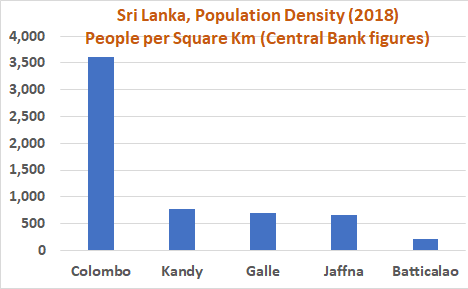
This virus has also warned us of the existential risk that comes with being packed together. The population density in Colombo, people per square km, is five times higher than in the other main cities of Sri Lanka.
2) Answer: What is your name?
3) Answer: What colour is your bicycle?