
HIP Hosts National Oil Spill Contingency Plan Workshop led by MEPA
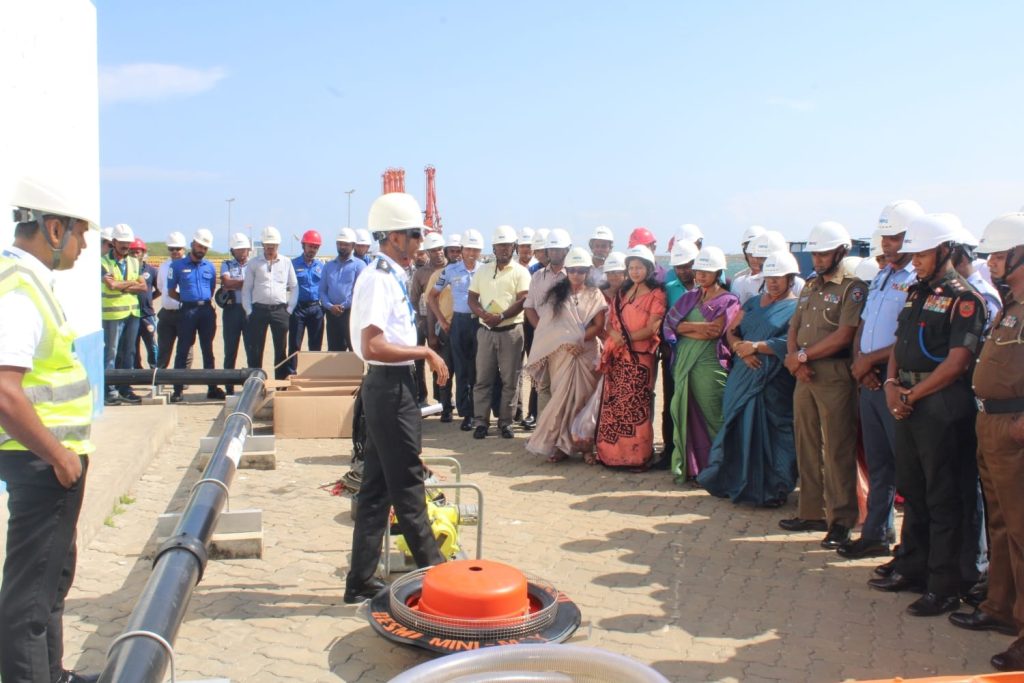
Hambantota International Port (HIP) recently hosted the National Oil Spill Contingency Plan Workshop, bringing together nearly 100 representatives from key public and private sector organizations to strengthen the district’s preparedness for marine oil spill incidents.
Conducted by the Marine Environment Protection Authority (MEPA) in line with Sri Lanka’s National Oil Spill Contingency Plan, the programme focused on coordinated emergency response, institutional responsibilities and the effective mobilisation of available resources during an incident.
Participants represented the Sri Lanka Ports Authority, Sinopec, Sri Lanka Navy, Army, Air Force, Coast Guard and Police, together with the Hambantota District Disaster Management Centre, Coast Conservation Department, Central Environmental Authority, District Secretariat, Divisional Secretariats and Provincial Council.
The workshop also drew representatives from the Department of Fisheries, NARA, Ocean University, fisheries harbours, National Water Supply and Drainage Board, Ceylon Electricity Board, Sri Lanka Telecom, Department of Wildlife Conservation, Ministry of Health, Sri Lanka Red Cross Society, HIP and MEPA. Their participation reflected the broad, multi-agency coordination required for an effective response to a marine pollution emergency.
Hambantota International PortServices (HIPS) CEO Wilson Qu said preparedness depended on ensuring that every stakeholder understood its responsibilities before an incident occurred. “An effective response to a marine emergency requires more than equipment. It requires trained people, clear responsibilities and strong coordination across every agency involved. By bringing these stakeholders together and combining technical knowledge with practical demonstrations, we are strengthening our collective ability to respond quickly and protect Hambantota’s marine environment. HIP remains committed to continuously enhancing its emergency readiness and supporting the wider national response framework,” he said.
The morning session featured technical presentations by MEPA District Marine Environment Officer Madura Delpachitra, MEPA Manager – Operations Nilantha Piyadasa and MEPA Assistant Manager – Operations Prabhath Amaranayaka. HIPS Senior General Manager Capt. Miyuru Gunasekara addressed the participants on behalf of the port.
The presentations covered the Hambantota District Oil Spill Contingency Plan, operational response procedures and the roles of the different organizations that may be mobilized during an emergency. They also highlighted the importance of timely communication and coordinated decision-making in containing an oil spill and limiting its impact on coastal communities and marine ecosystems.
The afternoon session moved from theory to practical preparedness with an oil spill response equipment demonstration at the port. Participants were introduced to the equipment available at HIP, briefed on its deployment and given an overview of the port’s emergency response capabilities.
The programme helped participants better understand how agencies, emergency services, regulators, infrastructure providers, and private sector organisations would work together during an incident. It also helped establish clearer links between the district-level response mechanism and Sri Lanka’s broader national contingency framework.
As a multipurpose port handling a growing range of maritime activities, HIP places environmental protection, operational safety and emergency preparedness at the centre of its operations. The workshop forms part of the wider effort led by MEPA to strengthen Sri Lanka’s capacity to manage marine pollution incidents through coordinated planning, stakeholder engagement and practical training.