
From Crisis Response to Climate Resilience: Innovating for Sri Lanka’s Agrifood Future
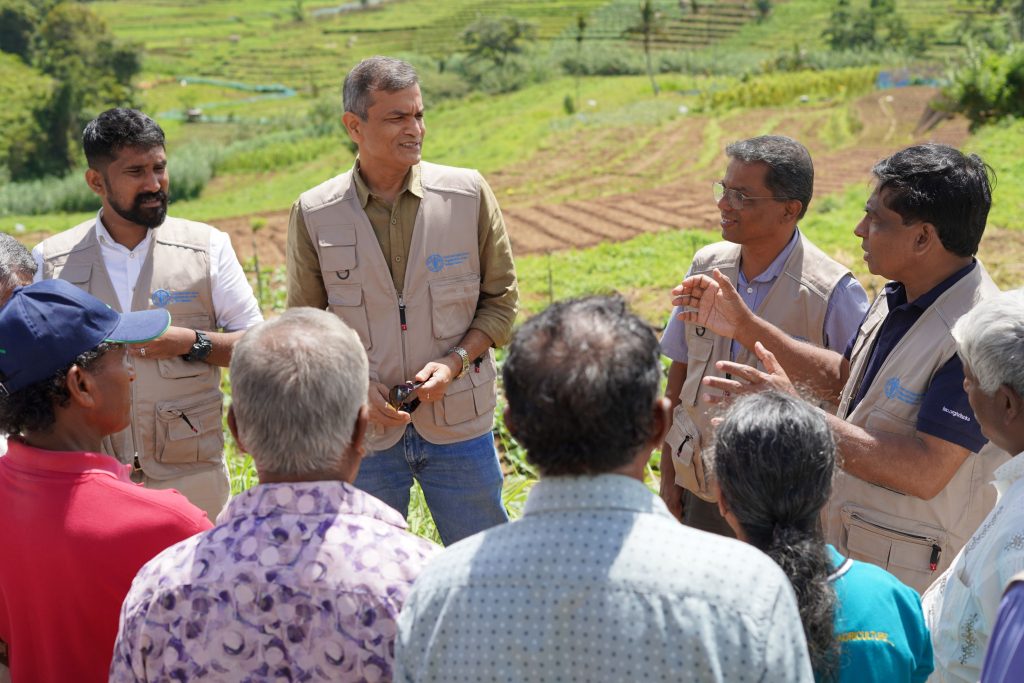
Vimlendra Sharan in discussion with vegetable farmers in Nuwara Eliya district
By Vimlendra Sharan, FAO Representative for Sri Lanka and the Maldives
When extreme weather destroys crops, damages infrastructure and disrupts supply chains, the consequences travel far beyond the farm. They reach food prices, family nutrition, rural incomes and public finances. Cyclone Ditwah exposed this vulnerability with painful clarity. With El Niño expected to bring further climatic pressures, Sri Lanka faces a critical choice: continue paying heavily after disasters, or invest in protecting livelihoods and production before hazards become humanitarian crises.
The economic stakes are enormous. The World Bank estimates that Cyclone Ditwah caused US$4.1 billion in direct physical damage, equivalent to about 4 percent of Sri Lanka’s GDP. Agriculture alone suffered an estimated US$814 million in damage. These are estimates of physical damage, not the full losses in income and production or the eventual cost of recovery. In a country with limited fiscal space, every preventable loss also diverts scarce resources from development to reconstruction.
As we mark World Food Day on 16 October, the theme ‘Innovate today. Nourish tomorrow.’ reminds us that safeguarding access to adequate, safe and nutritious food requires us to rethink how we produce, distribute and consume it. Innovation is not limited to new technologies. It also means changing how we anticipate climate risks, make decisions, mobilise finance and help farmers and fishers protect their livelihoods.
For Sri Lanka, the first priority is to turn early warning into early action. Credible forecasts, agreed trigger thresholds and local knowledge should guide the timely provision of short-duration seeds, fertiliser and other inputs; adjustments to planting calendars; protection of livestock and fishing assets; and practical advice on water management. A warning that reaches a farmer after the planting window has closed is of little use.
There is a compelling financial case for doing so. FAO’s global evidence shows that risk-informed early action in agriculture has generated up to US$7 in avoided losses and additional benefits for every US$1 invested. The World Meteorological Organization reports that investments in multi-hazard early warning systems yield an estimated US$9 in economic benefits per dollar invested. These are global findings, not guaranteed returns for every project, but they make one point unmistakable: preparedness is not an unaffordable extra; repeated preventable losses are.
Consider the scale. An illustrative US$10 million agricultural preparedness and early-action financing window would amount to only about 1.2 percent of Ditwah’s estimated US$814 million in agricultural damage. It would not eliminate disaster losses, nor is this a proposed budget. But a prearranged facility of this kind could release support rapidly when forecasts threaten a planting season, rather than wait until smallholders need more expensive assistance to replant, replace productive assets or recover lost incomes.
Other countries have shown what is possible. Bangladesh and India are examples from neighbouring countries where warnings, community networks and funds have been designed to work together. Nepal has demonstrated the financing side, arranging a US$150 million contingent disaster-financing facility before an emergency occurs.
FAO is supporting the Government of Sri Lanka in putting the same principle into practice. With national institutions and technical agencies, we are supporting an integrated Flood Anticipatory Action Protocol for Batticaloa, a drought trigger for Kurunegala and a weather-linked leptospirosis trigger connecting meteorological information with public health risks. We are also working with the Departments of Meteorology and Agriculture on operational drought forecasting and institutional disaster management planning. The aim is to translate risk information into timely, coordinated decisions.
Sri Lanka should now institutionalise preparedness financing, rather than mobilise it afresh during each emergency. That means setting aside a predictable early-action allocation, agreeing transparent forecast-based triggers and delivery responsibilities in advance, and using rapid channels such as digital input vouchers and shock-responsive social protection. Prearranged donor financing and suitable risk-financing instruments can complement domestic resources without assuming that additional public debt is always the answer. The test of success should be measurable: hectares planted on time, crops and livelihoods protected, losses avoided and households kept out of emergency assistance.
Alongside this immediate protection, resilience requires sustained investment in efficient irrigation, resilient seeds, climate-smart farming, accessible weather information and stronger agricultural extension services. Digital tools can link advice and risk data with timely support at the farm gate. In fisheries, risk-informed management and resilient landing, storage and supply chains matter just as much. Stronger systems require government, research institutions, the private sector and development partners to work towards shared priorities.
Innovation also means harnessing young people’s ideas. Through the World Food Day Youth Innovation Challenge, FAO, the Ministry of Education, Higher Education and Vocational Education, and Hatton National Bank are supporting young innovators to develop practical solutions for more resilient agrifood systems. Turning promising ideas into solutions that farmers and fishers can actually use is part of preparing for tomorrow.
Sri Lanka cannot prevent El Niño or eliminate climate hazards. It can, however, decide whether the next warning arrives with a plan, resources and the ability to act. Preparedness will never remove the need for emergency assistance, but it can reduce the damage that makes such assistance necessary. This World Food Day, the choice is not between spending now and spending later. It is between investing early to protect harvests, livelihoods and nutrition, or paying a much higher price when they are lost.