Fitch Upgrades 6, Affirms 2 Sri Lankan Insurers’ National IFS Ratings on Scale Recalibration
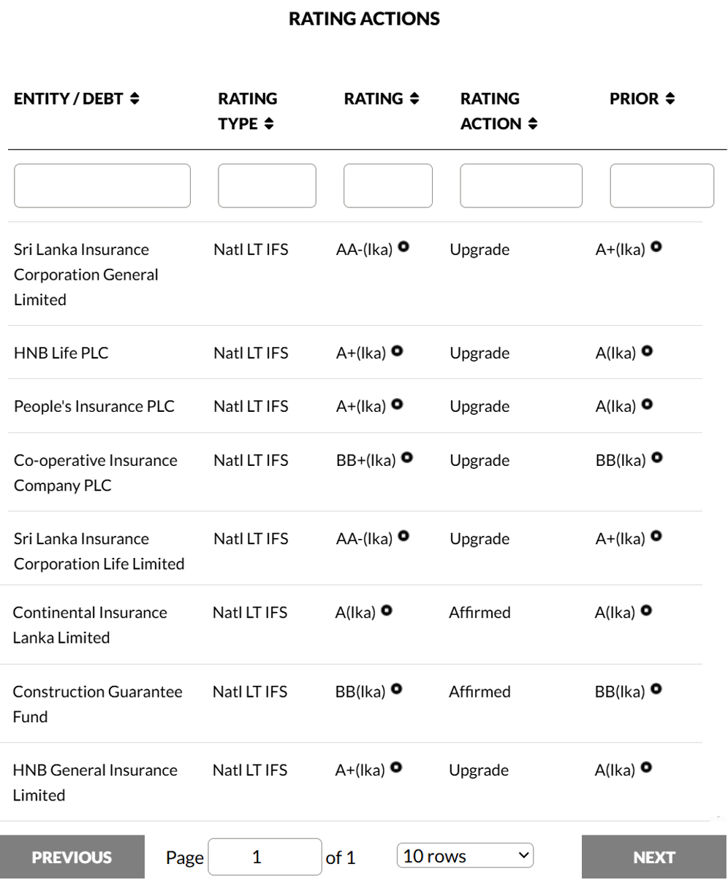
Fitch Ratings has taken the following actions on the National Insurer Financial Strength (IFS) Ratings on eight Sri Lankan insurers following recalibration of the agency’s Sri Lankan national rating scale following the recent sovereign rating upgrade:
— Sri Lanka Insurance Corporation Life Limited (SLIC Life): National IFS Rating upgraded to ‘AA-(lka) from ‘A+(lka)’; Outlook Stable
— Sri Lanka Insurance Corporation General Limited (SLIC General): National IFS Rating upgraded to ‘AA-(lka) from ‘A+(lka)’; Outlook Stable
— HNB Life PLC: National IFS Rating upgraded to ‘A+(lka) from ‘A(lka)’; Outlook Stable
— HNB General Insurance Limited (HNBGI): National IFS Rating upgraded to ‘A+(lka) from ‘A(lka)’; Outlook Stable
— People’s Insurance PLC: National IFS Rating upgraded to ‘A+(lka) from ‘A(lka)’; Outlook Stable
— Co-operative Insurance Company PLC (CICPLC): National IFS Rating upgraded to ‘BB+(lka)’ from ‘BB(lka)’; Outlook Stable
— Continental Insurance Lanka Limited (CILL): National IFS Rating affirmed at ‘A(lka)’; Outlook Stable
— Construction Guarantee Fund (CGF): National IFS affirmed at ‘BB(lka)’; Outlook Stable
The insurers’ National Ratings take into consideration their creditworthiness relative to those of other issuers in the country. National scale ratings are a risk ranking of issuers in a particular market designed to help local investors differentiate risk. Sri Lanka’s national scale ratings are denoted by the unique identifier ‘(lka)’. Fitch adds this identifier to reflect the unique nature of the Sri Lankan national scale. National scales are not comparable with Fitch’s international rating scales or with other countries’ national rating scales.
The national scale recalibration reflects changes in the relative creditworthiness of Sri Lankan issuers after Fitch upgraded Sri Lanka’s Long-Term Local-Currency Issuer Default Rating (IDR) to ‘B-’ with Stable Outlook from ‘CCC+’ on 22 September 2026. For details, see “Fitch Ratings Recalibrates Sri Lanka’s National Rating Scale“, dated 21 October 2026.
Key Rating Drivers
The National Rating upgrades are driven by the upgrade of Sri Lanka’s Long-Term Local-Currency IDR and the recalibration of the national rating scale and greater room for positive differentiation on the recalibrated national rating scale. The National IFS Rating upgrades of SLIC Life, SLIC General, HNB Life, HNB General, People’s Insurance and CICPLC reflect their relative creditworthiness, as differentiated by their company profiles, capitalization and financial performance.
We believe the sovereign’s credit profile improvement has reduced insurers’ investment and liquidity risks, which are closely linked to those of the sovereign and domestic banks because insurers’ investment portfolios are dominated by local-currency fixed-income government securities, corporate debt and deposits with financial institutions.
SLIC Life
SLIC Life’s rating upgrade reflects its ‘Favorable’ company profile, strong capitalization and strong profitability. SLIC Life and SLIC General are fully owned by the government of Sri Lanka.
Its company profile is supported by its long operating history, extensive franchise and broad distribution network, including a strong agency force. SLIC Life has remained Sri Lanka’s third-largest life insurer for the past three years, with a stable 14% share of life-insurance gross written premiums (GWP).
Capitalization remains a rating strength. SLIC Life maintained a risk-based capital (RBC) ratio above 400% during 2023-2025 and reported a ratio of 478% at end-1H26, exceeding those of Fitch-rated domestic life-insurance peers. SLIC Life’s average return on equity (ROE) of 16% over 2024-2025 has supported internal capital generation.
SLIC General
SLIC General’s rating upgrade reflects its ‘Favorable’ company profile, strong capitalization and strong profitability.
Its company profile is supported by its long operating history, leading franchise and broad distribution network. SLIC General has retained its position as the largest non-life insurer in Sri Lanka since 2024, with a 20% share of non-life GWP in 2025.
Capitalization remains a rating strength. SLIC General maintained an RBC ratio above 250% over the past two years and reported a ratio of 265% at end-1H26 which remains stronger than that of Fitch-rated domestic non-life-insurance peers. SLIC General’s average ROE of 12% and combined ratio of 103% during 2024-2025 compared favorably with Fitch-rated domestic non-life peers, although performance was weighed down by Cyclone Ditwah-related claims in 2025. Fitch expects gradual underwriting improvement through stronger claims management, and pricing discipline.
HNB Life and HNBGI
The upgrades of HNB Life and its wholly owned subsidiary, HNBGI, reflect the group’s ‘Favorable’ company profile, strong group profitability and satisfactory capitalization. Fitch expects HNB Life to provide capital support to HNBGI, if needed, to maintain adequate capital buffers and support business growth.
Their franchises benefit from their association with the parent, Hatton National Bank PLC (National Long-Term Rating: AA-(lka)/Stable), one of Sri Lanka’s largest private commercial banks. HNB Life was the sixth-largest life insurer, with an 8.6% share of life GWP in 2025, while its average GWP growth over 2023-2025 of 30% exceeded the industry average of 19%. HNBGI was the sixth-largest non-life insurer, with a 7.3% share of non-life GWP.
HNB Life’s average ROE was 19% during 2023-2025 while the group’s average ROE of 18% reflects strong profitability. HNBGI’s operating performance has improved, with its annualized ROE rising to 10% in 1H26 from an average of 8% in 2023-2025. Its combined ratio improved to 106% in 1H26, although its three-year average of 109% remained below the industry average.
The group’s capitalization is satisfactory. HNB Life’s RBC ratio remained above 250% in 2023-2025, although below the life-insurance industry average. HNBGI’s RBC ratio declined to 198% by end-1H26, from 219% in 2024.
People’s Insurance
The upgrade reflects People’s Insurance’s improving underwriting performance and strong capitalization.
Its company profile benefits from the People’s brand and its relationship with parent People’s Leasing & Finance PLC (National Long-Term Rating: AA-(lka)/Stable), which supports distribution and contributes materially through the group channel. It is Sri Lanka’s eighth largest non-life insurer in 2025, with a 5.6% share of GWP.
The insurer’s capitalization has been strong compared with rated non-life peers. Its RBC ratio has been above 240% over 2023-2025 and at 241% at end-1H26. Its operating performance has improved, with annualized ROE rising to 12% in 1H26 from 6% in 2025 and exceeding the three-year average of 8%, driven by stronger earnings from tighter underwriting and better investment returns. People’s Insurance’s combined ratio improved to 102% in 1H26, while its three-year average of 113% remained elevated, although below the industry average.
CICPLC
The upgrade reflects CICPLC’s ‘Moderate’ company profile, recovering profitability and satisfactory capitalization.
Fitch has revised CICPLC’s corporate governance assessment to ‘Neutral’ from ‘Less Favorable’, reflecting measures taken over the past two years to address prior weaknesses in its governance structure. CICPLC has an adequate franchise, supported by co-operative-society ownership, with a 3% share of non-life GWP and its position as the tenth-largest insurer in Sri Lanka in 2025.
CICPLC’s operating performance has strengthened from weak historical levels, with annualized ROE rising to 6% in 1H26 from a three-year average of 0.3% and the combined ratio improving to 109% in 1H26, from 115% in 2025. However, profitability and underwriting performance remain weaker than those of higher-rated Fitch-rated domestic non-life peers. Capitalization is satisfactory, with the RBC ratio remaining above 200% in 2023-2025 and standing at 210% at end-1H26.
CILL
CILL’s rating reflects its moderate company profile and satisfactory regulatory capital position, which are offset by its weaker underwriting performance relative to peers.
CILL was the seventh-largest non-life insurer in Sri Lanka in 2025, with a GWP market share of 6.8%. Its business mix is more diversified than that of most domestic non-life insurers, reflecting its larger presence in non-motor business lines. Its regulatory capitalization remained satisfactory, with an RBC ratio of 222% at end-1H26 (end-2025: 230%).
CILL’s underwriting performance weakened in 2025. The combined ratio rose to 119% from 100% in 2024, due to high medical claims and adverse claims development in health. This resulted in a net loss of LKR654 million in 2025 (2024: profit of LKR436 million). Its recent performance has been weak relative to Fitch-rated domestic non-life insurers, with the combined ratio at 113% in 1H26. CILL’s continued losses could weaken its regulatory capitalization.
Ownership of CILL is in the process of being transferred from Melstacorp PLC (National Long-Term Rating: AAA(lka)/Stable) to Janashakthi PLC. Janashakthi proposes to initially acquire an 81% stake in CILL, with the remaining 19% to be transferred in two tranches of 9% and 10% over the subsequent two years. The transaction remains subject to final approval from the Insurance Regulatory Commission of Sri Lanka.
CGF
The affirmation reflects CGF’s ‘Moderate’ company profile and improving operating conditions in Sri Lanka’s construction sector, which are offset by CGF’s historically volatile performance.
CGF is fully state-owned, with the Secretary to the Treasury acting as the trust’s settlor. It serves a niche market by providing guarantees and related services to SME contractors involved in government projects.
A growing foreign-funded infrastructure pipeline supported demand for CGF’s bonds and guarantees, driving a material recovery in core guarantee income in 1H26. CGF’s average ROE was 13% in 2023-2025, although investment income, rather than guarantee operations, remained the main contributor to profitability.
Capitalization was adequate, supported by internally generated surplus and total capital of about LKR2.0 billion at end-2025. Net guarantee risk exposure was modest at 0.6x total equity. However, CGF’s earnings and business volumes remain sensitive to the pace of project implementation and broader conditions in the domestic construction sector.
RATING SENSITIVITIES
Factors that Could, Individually or Collectively, Lead to Negative Rating Action/Downgrade
SLIC Life
– Prolonged weakness in financial performance;
– A deterioration in the RBC ratio to below 300% for a sustained period;
– Rising investment and asset risks, including a downgrade of the ratings of financial institutions or the sovereign, which account for a large share of SLIC Life’s investment portfolio.
SLIC General
– Sustained weakness in financial performance;
– Deterioration in the RBC ratio to below 220% for a sustained period;
– Rising investment and asset risks, including a downgrade of the ratings of financial institutions or the sovereign, which account for a large share of SLIC General’s investment portfolio.
HNB Life and HNBGI
– Deterioration in HNB Life’s RBC ratio to below 240% or a significant deterioration in HNBGI’s capital position for a sustained period;
– Sustained deterioration in financial performance or weaker risk-management practices;
– Rising investment and asset risks, including a downgrade of the ratings of financial institutions or the sovereign.
CICPLC
– Deterioration in the company profile, including a weaker franchise and competitive positioning, or Fitch’s perception that the insurer’s corporate governance practices have deteriorated;
– Sustained deterioration in financial performance, or weaker risk-management practices;
– Rising investment and asset risks, including a downgrade of the ratings of financial institutions or the sovereign.
CILL
– Deterioration in the company profile, including a weaker franchise and competitive positioning, or Fitch’s perception that the insurer’s corporate governance practices have deteriorated;
– Deterioration in the RBC ratio to below 220% for a sustained period;
– Sustained deterioration in financial performance, or weaker risk-management practices;
– Rising investment and asset risks, including downgrades of the ratings on the Sri Lanka sovereign or domestic financial institutions.
People’s Insurance
– Deterioration in the regulatory RBC ratio to below 200% for a sustained period;
– Sustained deterioration in financial performance or weaker risk-management practices;
– Rising investment and asset risks, including a downgrade of the ratings on Sri Lankan financial institutions or the sovereign.
CGF
– Sustained deterioration in financial performance or weaker risk-management practices;
– Deterioration in the company profile, for instance, due to a significant weakening in CGF’s association with the government, or deterioration in its business risk profile due to a decline in the country’s economic conditions that affects the domestic construction sector;
– Rising investment and asset risks, including a downgrade of the ratings of financial institutions or the sovereign.
Factors that Could, Individually or Collectively, Lead to Positive Rating Action/Upgrade
SLIC Life
– Further improvement in the company profile, including a greater operating scale and a stronger market positioning
SLIC General
– Further improvement in the company profile, including a greater operating scale and stronger market position;
– An improvement in the risk-based capital ratio to well above 300% while maintaining the combined ratio at below 95%.
HNB Life and HNBGI
– An improvement in the RBC ratio to well above 320% at HNB Life and 250% at HNBGI, while maintaining the combined ratio below 98% for HNBGI;
– Further improvement in the company profile, for instance, from a stronger business franchise and larger operating scale.
CICPLC
– Further improvement in the company profile, including a stronger business franchise and greater operating scale;
– Maintaining its combined ratio well below 105% for a sustained period, while our assessment of the insurer’s capitalization remains unchanged.
CILL
– Maintaining its combined ratio below 98% for a sustained period, while our assessment of the insurer’s capitalization remains unchanged.
– Sustained improvement in the company profile, including a further expansion in its operating scale and business franchise
People’s Insurance
– An improvement in the RBC ratio to well above 240% and maintaining the combined ratio below 98% consistently for a sustained period;
– Improving the business profile in terms of broader diversification of business lines.
CGF
– Sustained improvement in the company profile in terms of a larger operating scale and successful diversification into profitable and stable business lines.
REFERENCES FOR SUBSTANTIALLY MATERIAL SOURCE CITED AS KEY DRIVER OF RATING
The principal sources of information used in the analysis are described in the Applicable Criteria.