Fitch Upgrades Bank of Ceylon’s IDRs to ‘B-‘, VR to ‘b-‘; Outlook Stable
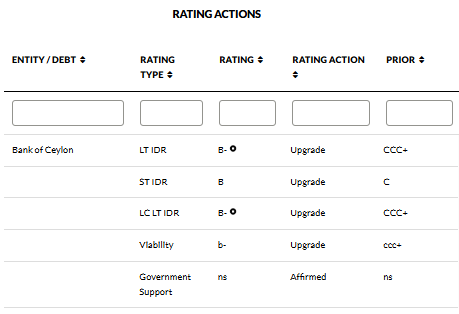
Fitch Ratings has upgraded Bank of Ceylon’s (BOC) Long-Term Foreign- and Local-Currency Issuer Default Ratings (IDRs) to ‘B-’, from ‘CCC+’, with a Stable Outlook. Fitch has also upgraded BOC’s Viability Rating (VR) to ‘b-’, from ‘ccc+’, and Short-Term IDR to ‘B’, from ‘C’. The Government Support Rating (GSR) has been affirmed at ‘ns’ (no support).
BOC’s National Long-Term Rating of ‘AA-(lka)’/Stable was not considered in this review.
The rating actions follow the upgrade of Sri Lanka’s Long-Term Foreign- and Local-Currency IDRs to ‘B-’/Stable, from ‘CCC+’, on 22 September 2026. For details, see Fitch Upgrades Sri Lanka to ‘B-’; Outlook Stable.
Key Rating Drivers
Improved Sovereign Strengthens BOC’s Profile: The upgrade of BOC’s VR and IDRs reflects the upgrade of Sri Lanka’s sovereign rating, as the sovereign credit profile is a key constraint on the bank’s ratings. We believe the sovereign’s structural reforms have eased external financing risk and improved the economy’s resilience to shocks. This should underpin greater financial-market stability and support BOC’s business, risk and financial prospects.
Easing Operating Environment Risks: We have raised our operating environment (OE) score for Sri Lankan banks to ‘b-’, from ‘ccc+’, as the sovereign upgrade indicates easing direct and indirect risks that constrain the bank OE. Even so, the banking sector remains closely tied to the domestic economy, with significant exposure to the sovereign and quasi-sovereign entities through government securities and wider public-sector lending.
Market Leadership a Rating Strength: We have revised up BOC’s business profile score to ‘b’, from ‘b-’, reflecting its position as Sri Lanka’s largest bank, with around 22% of sector assets and deposits. We believe BOC’s extensive branch network and funding franchise give it an advantage in generating business at acceptable risk and that the improved OE should enhance its prospects over the medium term.
Sovereign Exposure Dominates Risk Profile: We have revised up BOC’s risk profile and asset quality scores to ‘b-’, from ‘ccc+’, as the improved sovereign credit profile eases portfolio risk from BOC’s large state-linked exposure. We estimate sovereign bonds and loans to state-owned entities comprised about 60% of BOC’s total assets at end-1Q26, including treasury securities held for liquidity purposes.
Economic Resilience Supports Profitability: The sovereign’s stronger credit profile should bolster Sri Lanka’s resilience to economic shocks, which we expect to lower earnings volatility over the medium term. This has led us to revise up BOC’s earnings and profitability score to ‘b’, from ‘b-’, even though moderately higher funding costs and lower interest income from government securities could weigh on near-term profitability.
Easing Capital Impairment Risk: We have revised up BOC’s capitalisation and leverage score to ‘b-’, from ‘ccc+’, reflecting reduced risk to capitalisation from the bank’s sovereign and quasi-sovereign exposures. Non-sovereign credit risk is also falling, as the sovereign’s stronger credit profile feeds through to the domestic economy.
Improved Funding Stability: We have revised upBOC’s funding and liquidity score ‘b-’, from ‘ccc+’, as we expect the stronger sovereign credit profile to boost stability in domestic funding and liquidity conditions. Access to foreign-currency funding should also widen gradually.
State Support Capacity Constrained: We have affirmed the GSR at ‘ns’, as we believe the government’s weak finances and modest foreign reserves continue to constrain its ability to provide extraordinary support.
Rating Sensitivities
Factors that Could, Individually or Collectively, Lead to Negative Rating Action/Downgrade
A downgrade of BOC’s Long-Term Foreign- or Local-Currency IDRs and VR is most likely to stem from a sovereign downgrade, which would constrain BOC’s standalone credit profile. A significant deterioration in the OE or renewed foreign-currency funding and liquidity constraints could also lead to a downgrade of the ratings.
Factors that Could, Individually or Collectively, Lead to Positive Rating Action/Upgrade
An upgrade of BOC’s Long-Term Foreign- and Local-Currency IDRs and VR would most likely result from an improved sovereign credit profile and banking sector OE, which would reduce operating risk and strengthen the bank’s financial profile.
A sustained improvement in the sovereign’s financial flexibility could also prompt us to reassess the likelihood of state support and potentially upgrade BOC’s GSR.
BOC has a 1.78% equity stake in Fitch Ratings Lanka Ltd. No shareholder other than Fitch, Inc. is involved in the day-to-day rating operations of, or credit reviews undertaken by, Fitch Ratings Lanka.
VR ADJUSTMENTS
The earnings and profitability score of ‘b’ is below the ‘bb’ category implied score due to the following adjustment reason: earnings stability (negative).