
Opinion: A way forward for Sri Lanka to capitalize on the new Indian ocean order
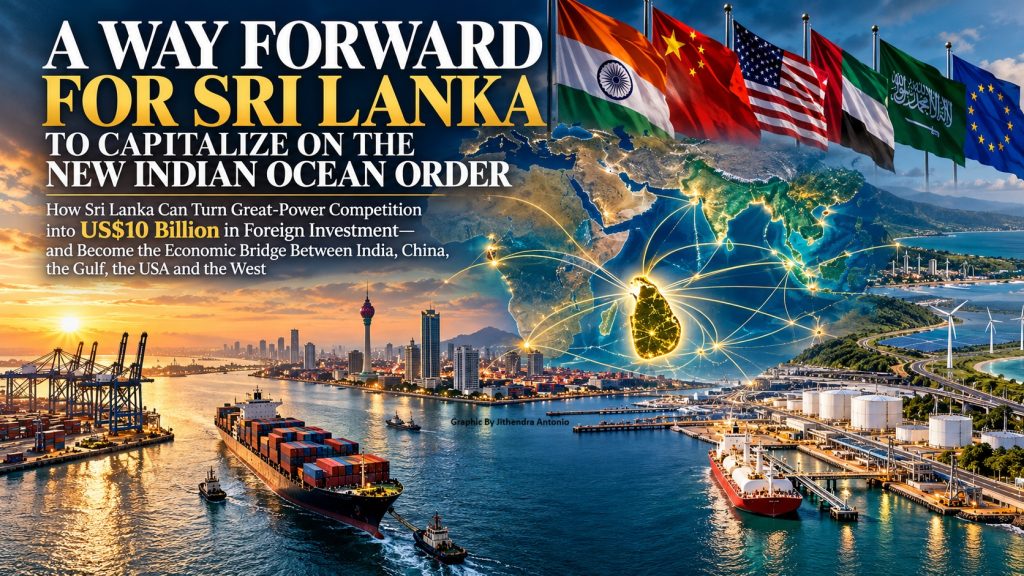
How Sri Lanka Can Turn Great-Power Competition into US$10 Billion in Foreign Investment—and Become the Economic Bridge Between India, China, the Gulf, the USA and West
By Jithendra Antonio
From Trincomalee’s energy reserves to Colombo’s maritime gateway, from Hambantota’s industrial potential to Mannar’s renewable-energy frontier, Sri Lanka has an opportunity to transform its geography into economic power. The challenge is to attract capital from competing powers without surrendering the freedom to decide its own future.
The warning from an Indian Ocean strategist
In June 2026, Indian Ocean security entered a fresh round of scrutiny when Keerthi Martyn published “Navigating the Currents: Sri Lanka’s National Security Debate in the New Indian Ocean Order” through the Observer Research Foundation, subsequently republished by the Center for a New American Security. (Link –https://www.orfonline.org/public/uploads/upload/20260623112717.pdf )
Martyn’s assessment raises an uncomfortable question for Colombo – Can Sri Lanka preserve its freedom of action when its location, infrastructure and economic vulnerabilities make it increasingly important to larger powers?
The chapter opens with a striking geographical observation. Sri Lanka lies at the crossroads of the Indian Ocean, approximately 10 nautical miles from major sea lanes carrying a substantial share of global energy and container traffic. Martyn argues that this location makes the island both a significant maritime actor and a focus of strategic competition. He identifies intensifying US–China rivalry, China’s infrastructure investments, American maritime-security partnerships and India’s growing influence over Sri Lanka’s security and defence decisions as central pressures shaping the island’s choices.
The opening passage also cites a previous article I wrote on January 27, 2025, widely published article, “Sri Lanka’s Maritime Revolution: Must-Do Strategy to Unlock Global Trade Power from Heart of Indian Ocean,” as a reference supporting the strategic significance of Sri Lanka’s location. The citation places the island’s maritime potential within a wider debate about national security and international competition.
Martyn’s argument extends beyond geography. His assessment highlights the risks posed by domestic governance weaknesses, limited maritime capabilities, inadequate preparedness for supply-chain disruptions and the difficulty of maintaining strategic flexibility when external powers pursue competing interests. His discussion of the 2026 Iran crisis illustrates how quickly diplomatic choices, maritime incidents and energy vulnerabilities can become interconnected.
The Indian Ocean, meanwhile, is not a contest involving only three capitals. It connects India, China, the United States, the Gulf states, Israel and the wider Middle East with Singapore, Japan, South Korea, Australia, Indonesia, Malaysia, Thailand, Bangladesh, Pakistan, the Maldives, East Africa and Europe. Each has different commercial, diplomatic or security interests in the region.
The result is a complicated environment in which ports, energy terminals, telecommunications, shipping routes, data infrastructure and investment agreements can acquire significance far beyond their immediate commercial purpose.
But there is another way to read the emerging order.
What if Sri Lanka stopped treating great-power competition principally as a threat to be managed and began treating it as an economic opportunity to be structured?
What if Colombo could attract Indian manufacturing, Chinese industrial investment, American technology, Gulf capital and Israeli innovation under a transparent national framework—while retaining control over its own laws, infrastructure and strategic decisions?
That is the economic proposition at the heart of this article.
The New Indian Ocean Order does not guarantee Sri Lanka a fortune. It creates an opportunity for the island to earn one.
The Ambition – US$10 billion in additional FDI over 20 years
Sri Lanka should adopt a national target of attracting US$10 billion in additional realised foreign direct investment between 2027 and 2046, separate from investment already counted under Colombo Port City.
The target is a proposed policy ambition, not an existing government commitment or a forecast of guaranteed investment.
The arithmetic is straightforward – US$10 billion over 20 years represents an average of US$500 million annually. The harder task is to attract that money consistently, direct it towards productive sectors and ensure that it generates exports, employment, technology transfer and tax revenue.
Sri Lanka has demonstrated that investment on a billion-dollar annual scale is possible, although official figures vary according to whether loans, reinvested earnings and other forms of capital are included. The Central Bank of Sri Lanka and the Board of Investment should therefore establish a common public reporting framework that distinguishes equity capital, intercompany borrowing, reinvested earnings, acquisitions and greenfield investment.
The national target should count money actually deployed, not merely memoranda signed or projects announced.
It should also measure the results: new export revenue, skilled employment, local supplier participation, wages, technology transfer and the amount of foreign exchange retained in the economy.
Sri Lanka needs neither a slogan nor another collection of investment announcements. It needs a pipeline of bankable projects supported by credible institutions.
1. India – Convert Geographic Proximity into an Economic Partnership
India deserves its own strategic chapter in Sri Lanka’s investment plan—not because every Indian proposal should automatically be accepted, but because the two countries share a geography that no change in government or international alignment can remove.
India is a major economic power, a significant source of Sri Lankan tourism, an important trade partner and a country whose maritime security is closely connected to developments around the island. Its manufacturing base, digital economy, consumer market and energy requirements offer Sri Lanka opportunities that extend well beyond traditional bilateral trade.
The High Commission of India in Colombo reports bilateral merchandise trade of approximately US$7.1 billion in financial year 2025–26 and cumulative Indian investment in Sri Lanka of approximately US$2.8 billion, based on Central Bank data. India also became Sri Lanka’s largest source market for tourist arrivals in 2025. These existing connections provide a foundation for further commercial integration. (Source: High Commission of India, Colombo—India–Sri Lanka Economic and Trade Engagement.)
The question is how to move from an established relationship towards a more productive economic partnership.
A) Build a Sri Lanka–India Manufacturing and Export Corridor
Sri Lanka should identify industries in which its workforce, location and existing industrial capabilities can complement India’s much larger market.
Potential areas include specialised apparel, rubber-based products, processed food, marine equipment, medical supplies, industrial components and selected engineering services. These are candidates for feasibility studies, not automatic investment winners.
The government should create a joint project pipeline that identifies the products India imports competitively, the products Sri Lanka can manufacture efficiently and the markets accessible through regional trade agreements.
Projects should be evaluated against landed production costs, rules of origin, electricity prices, shipping expenses and demand from actual buyers.
The objective is to make Sri Lanka a complementary production location—not a substitute for the Indian economy.
B) Turn Trincomalee into an Energy and Logistics Partnership
The Trincomalee energy-hub initiative provides a practical example of how regional economic cooperation can work.
In April 2025, Sri Lanka, India and the United Arab Emirates signed a memorandum of understanding to cooperate in developing Trincomalee as an energy hub. The framework includes potential cooperation on the oil-tank farm and associated energy infrastructure. (Source: Announcement by President’s Office of Sri Lanka, 5 April 2025)
The next phase should identify commercially viable investments in storage, marine fuels, bulk-liquid handling, pipelines, distribution and industrial logistics. A refinery should proceed only if independent analysis establishes a sustainable business case, including feedstock availability, market demand, financing costs and environmental compliance.
C) Connect the Electricity Systems
A high-voltage direct-current interconnection between India and Sri Lanka could eventually enable electricity exchange and improve the commercial utilisation of renewable power, subject to final engineering, regulatory and financing arrangements.
The two governments exchanged an understanding on electricity interconnection in April 2025. India’s official briefing described the initiative as a way to support lower-cost electricity and potentially enable Sri Lanka to export clean energy. (Source: High Commission of India—April 2025 briefing.)
Sri Lanka should prepare its generation, transmission and regulatory systems so that it can benefit from such connectivity rather than simply becoming a passive electricity purchaser.
D) Develop Digital and Professional Services
The island can serve businesses that need regional expertise, multilingual customer support, software development, accounting, engineering, compliance, logistics management and other internationally tradable services.
A joint programme with Indian companies and universities could establish specialised training centres, digital-service operations and export-oriented technology businesses.
This is an area in which Sri Lanka can benefit from Indian economic growth without attempting to replicate the entire scale of India’s technology industry.
The larger Strategic Dividend
A more prosperous and economically connected neighbourhood can create opportunities for Sri Lanka to strengthen its maritime services, energy links and industrial capabilities.
The concept sometimes described as Pax India—an Indian Ocean environment in which India’s economic scale and regional relationships contribute to stability and connectivity—should be treated as a possible strategic framework, not an established doctrine or a guarantee of Indian support.
Sri Lanka’s interest is to make the relationship commercially valuable to both countries while preserving its sovereign right to negotiate the terms of every project.
The strongest partnership is not one in which Colombo depends on New Delhi to solve every economic problem. It is one in which both countries benefit from a more productive, connected and stable region.
2. China – Welcome Industrial Capital, But Make Every Project Earn its Place
China remains a major participant in Sri Lanka’s infrastructure and industrial development. Its construction capabilities, manufacturing ecosystem, financing networks and experience in large-scale industrial projects make it an important potential investor.
Yet the economic question is not whether a project is Chinese or Indian. It is whether the project generates sufficient value for Sri Lanka.
That distinction matters because infrastructure can become an asset or a liability depending on the terms of financing, the level of utilisation, the allocation of risk and the revenue it produces.
Sri Lanka should pursue a more sophisticated relationship with Chinese capital: one that welcomes viable investments while insisting on transparent contracts, sound financing, environmental safeguards and measurable economic outcomes.
A) Hambantota – Build an Industrial Economy around the Port
In January 2025, the Sri Lankan Embassy in Beijing announced an agreement with Sinopec for a proposed US$3.7 billion refinery in the Hambantota region, with a stated processing capacity of 200,000 barrels per day and a substantial export orientation.
Source: Embassy of Sri Lanka in Beijing, 16 January 2025.
The announcement represents a substantial industrial ambition. Its ultimate contribution will depend on implementation, financing, feedstock arrangements, market demand, environmental performance and the terms governing the investment.
A refinery should not be evaluated solely by its headline value. The relevant questions are whether it will generate net foreign exchange, whether its output can be sold competitively, whether Sri Lankan workers and suppliers will participate and whether public finances are protected from unanticipated liabilities.
The wider opportunity is to create an industrial ecosystem around Hambantota that can support warehousing, port services, industrial maintenance, packaging, engineering, export manufacturing and logistics.
If a refinery proceeds, it should become an anchor for commercially viable activity—not an isolated project surrounded by empty industrial land.
B) Industrial Parks and Export Manufacturing
Chinese companies could be invited to develop or participate in export-oriented manufacturing projects in sectors such as industrial components, machinery, electronics assembly, rubber products and selected consumer goods.
Sri Lanka should not compete for factories simply by offering cheap land or tax concessions. It should compete by reducing the total cost of producing and exporting goods.
That means reliable electricity, efficient customs, good transport links, skilled workers and predictable regulations.
Investment agreements should specify employment targets where appropriate, environmental obligations, local-supplier opportunities and transparent reporting.
C) Maritime Technology and Port Operations
China’s expertise in port construction, logistics systems and industrial infrastructure may support selected projects in port management, cargo handling, warehousing and digital logistics.
However, projects involving critical infrastructure require appropriate cybersecurity, data-protection and national-security assessments. Sri Lanka should retain the ability to inspect, regulate and protect essential systems.
D) Renewable Energy and Industrial Technology
Chinese companies are major participants in global solar, battery and electric-vehicle supply chains. Sri Lanka could invite competitive proposals for renewable-energy equipment, storage, grid technology and export-oriented manufacturing where local conditions justify the investment.
Procurement should be open to qualified suppliers from different countries, with decisions based on lifecycle cost, reliability, financing and technical performance.
The Principle
China should remain an economic partner, but not an economic exception.
No foreign investor should receive favourable treatment that cannot be justified under a transparent national framework. No project should be described as a success merely because it carries a multibillion-dollar price tag.
The real test is whether Sri Lanka becomes more productive, more export-capable and less vulnerable after the investment.
3. The United States – Turn Maritime Security into a Wider Commercial Relationship
The United States has a significant interest in freedom of navigation, regional stability, maritime awareness and the resilience of international supply chains. These interests overlap with Sri Lanka’s need for safe shipping routes, reliable infrastructure and a more diversified export economy.
But the relationship should extend beyond naval cooperation and diplomatic engagement.
Sri Lanka should make itself more attractive to American businesses seeking skilled workers, regional access, reliable digital infrastructure and an export-oriented operating base.
A) Digital Services and Technology
Potential investment areas include software engineering, cloud services, business-process operations, cybersecurity, financial technology, data infrastructure and specialised professional services.
These businesses can generate foreign exchange without requiring every investment to take the form of a large physical industrial complex.
The conditions for attracting them are practical: dependable electricity, robust connectivity, data-protection rules, intellectual-property safeguards, professional skills and predictable regulation.
B) Maritime Logistics and Supply-Chain Services
Sri Lanka can explore commercial partnerships involving vessel services, cargo visibility, logistics software, shipping support and supply-chain management.
A modern port is not merely a place where containers are lifted from ships. It is a node in a global information network.
The country should invest in interoperable cargo documentation, modern customs systems, vessel scheduling and reliable data exchange. Those improvements can make Sri Lanka more useful to shipping companies and manufacturers across multiple countries.
C) Advanced Manufacturing and Agricultural Technology
American firms could participate in selected projects involving medical technology, specialised manufacturing, food processing, agricultural technology and industrial automation.
The government should target companies with a clear commercial rationale for locating in Sri Lanka and assess each proposal on its own merits.
D) Maritime Resilience and Disaster Preparedness
Maritime surveillance, search and rescue, disaster response and supply-chain resilience are areas where international cooperation can support national capacity.
Sri Lanka should pursue partnerships that improve its ability to protect its waters, respond to emergencies and maintain essential imports during crises.
Security cooperation should strengthen the country’s own institutions and capabilities, not create unnecessary dependence on any single external partner.
The Commercial Objective
The United States should be one of several major sources of investment and technology for Sri Lanka. The island should not expect Washington to finance its entire development strategy, nor should it allow geopolitical disagreements to prevent commercially valuable cooperation.
A predictable business environment is the most persuasive investment promotion campaign Sri Lanka can conduct.
4. The seven Gulf states – Connect Capital with Energy, Logistics and Global Markets
The Gulf should be treated as a diverse investment region rather than a single pool of oil money.
The seven states most relevant to a wider Sri Lankan Gulf investment strategy are the United Arab Emirates, Saudi Arabia, Qatar, Kuwait, Oman, and Bahrain. The six are members of the Gulf Cooperation Council.
Their investment capabilities differ. Sri Lanka should approach each according to its financial institutions, energy sector, logistics networks, industrial priorities and appetite for overseas investment.
A) United Arab Emirates – Logistics, Ports and International Business
The UAE is a natural candidate for investment in logistics, port-linked services, energy infrastructure, warehousing, tourism and international business operations.
Its experience in maritime logistics and global connectivity could be particularly relevant to Colombo, Hambantota and Trincomalee.
The trilateral Trincomalee energy-hub memorandum involving Sri Lanka, India and the UAE already provides an institutional starting point for further commercial work.
Sri Lanka should seek investment proposals with clearly defined ownership, financing, operational responsibilities and expected revenue. It should also examine opportunities in cold-chain logistics, aviation-linked tourism, maritime services and regional distribution.
B) Saudi Arabia – Energy, Industry and Tourism
Saudi Arabia’s economic diversification programme creates potential opportunities beyond conventional petroleum investment.
Sri Lanka could explore renewable energy, energy storage, tourism infrastructure, industrial services, food processing and selected logistics projects.
The priority should be to identify projects that fit the commercial objectives of Saudi investors while creating durable economic activity in Sri Lanka.
Large tourism developments, for example, should be supported by independent assessments of demand, water use, environmental impact and infrastructure capacity.
C) Qatar – Energy, Finance and Aviation Connectivity
Qatar’s strengths in energy, aviation, investment and international business create potential for partnerships in logistics, energy infrastructure, hospitality and financial services.
Sri Lanka should explore commercially viable investment and co-financing opportunities, including projects that improve connectivity between the island and major international markets.
The focus should be on projects that produce measurable income and employment rather than relying on broad diplomatic statements about future cooperation.
D) Kuwait – Institutional Capital and Infrastructure
Kuwait offers a potential source of investment through financial institutions, investment vehicles and private businesses.
Sri Lanka should prepare professionally assessed opportunities in infrastructure, energy, property development and export-oriented industries.
Projects should have clear revenue models and transparent risk allocation. Where public guarantees are requested, their fiscal cost should be disclosed.
E) Oman – Maritime Services, Energy and Logistics
Oman’s position along important maritime routes and its experience in ports, logistics and energy provide a potential basis for cooperation.
Sri Lanka could explore port services, shipping support, marine maintenance, fuel logistics and selected renewable-energy projects.
The two countries could also examine opportunities in maritime training and technical services.
F) Bahrain – Financial Services and Fintech
Bahrain’s financial-services sector provides a potential partner for Sri Lanka’s ambition to develop international business, financial technology, compliance and professional services.
Any such initiative should depend on credible regulation, appropriate anti-money-laundering safeguards, investor protection and the ability to serve genuine commercial customers.
Sri Lanka should not pursue a financial-services strategy based on regulatory shortcuts. Its competitive advantage must be trust.
One Gulf strategy, Six Differentiated Approaches
Sri Lanka should establish a Gulf Investment Programme that identifies specific investors, project requirements, financing conditions and implementation timelines.
It should not assume that every Gulf state has the same investment capacity or priorities. Nor should it confuse memoranda of understanding with money committed.
The programme should be supported by a professional project-preparation team capable of presenting bankable proposals in energy, logistics, manufacturing, tourism and services.
The goal is to convert diplomatic relationships into transactions that survive commercial due diligence.
5. Israel – Technology Partnerships in Water, Agriculture and Resilience
Israel offers a distinct set of potential partnerships in specialised technology, particularly in water management, irrigation, precision agriculture, cybersecurity and selected medical technologies.
Sri Lanka faces practical challenges involving agricultural productivity, water efficiency, climate resilience and the protection of digital infrastructure. Technology partnerships could help address these issues if the solutions are adapted to local conditions.
A) Water and Agricultural Productivity
Potential projects include precision irrigation, soil monitoring, greenhouse technology, water treatment and systems that improve crop yields while reducing resource use.
Sri Lanka should begin with pilot projects and independent evaluations rather than assume that a technology developed for one environment will automatically work in another.
Successful pilots could then be scaled through transparent procurement and partnerships with local agricultural institutions.
B) Food Processing and Agricultural Exports
Improved agricultural technology could be linked to cold-chain logistics, food processing, quality assurance and export certification.
The aim should be to increase the value earned by Sri Lankan producers, not merely to import more equipment.
C) Cybersecurity and Critical Infrastructure
As Sri Lanka digitises ports, energy systems, financial services and public administration, the need for robust cybersecurity will grow.
Specialist international providers, including Israeli firms, could compete to deliver security systems, training and risk-management services.
Such projects should be subject to clear rules governing data ownership, access, system integrity and national oversight.
D) Medical and Specialised Technology
Sri Lanka could also explore partnerships in selected medical technologies and healthcare services where there is a demonstrable clinical and commercial case.
The objective should be better services, local skills and sustainable costs—not technology imports for their own sake.
Israel should be one of several international technology partners. Commercial decisions should follow transparent procurement, national law and an assessment of each project’s benefits and risks.
6. The wider Indian Ocean – Singapore, Japan, South Korea and the ASEAN Economies
A strategy focused only on India, China, the United States, the Gulf and Israel would miss other valuable sources of expertise and capital.
Singapore has extensive experience in port operations, trade facilitation, financial services and regional business management. Sri Lanka could work with Singaporean companies to improve logistics, professional services and internationally tradable business operations.
Japan and South Korea could contribute to industrial technology, transport, energy systems, advanced manufacturing and workforce development.
Australia could be a partner in education, maritime cooperation, tourism and selected resource and technology projects. Indonesia, Malaysia and Thailand offer opportunities in food processing, manufacturing, tourism and regional trade.
The European economies can contribute to renewable energy, advanced manufacturing, sustainable infrastructure, professional services and technology.
These relationships should be treated as complements to, not replacements for, the larger investment partnerships described above.
The strategic advantage of Sri Lanka is not that it must choose a single centre of economic gravity. It is that the island can connect several markets if its institutions and infrastructure are sufficiently reliable.
7. The Project Pipeline – Where the US$10 Bn could go
The following table presents a proposed 20-year investment allocation. These figures are planning assumptions, not secured financing or official government commitments.
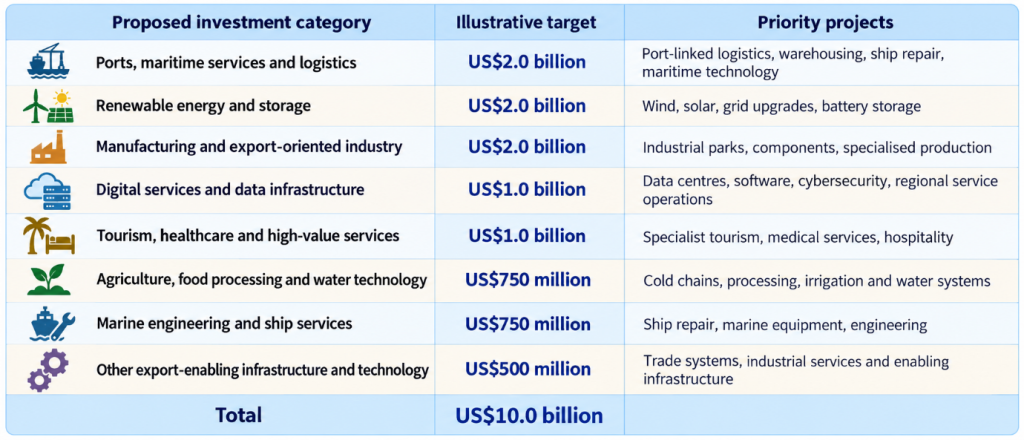
The categories should be refined through feasibility studies and investor discussions. A project spanning several sectors must be counted only once.
Trincomalee – An Energy and Logistics Hub
Develop storage, marine fuels, liquid-bulk handling, pipelines and associated logistics where commercial studies support the investment.
Hambantota – A Port-Linked Industrial Economy
Attract export manufacturers and industrial service companies that can use the port efficiently, subject to infrastructure readiness and proven demand.
Colombo – Higher-Value Maritime and Financial Services
Expand ship services, cargo finance, insurance, logistics technology and professional services that earn foreign exchange.
Mannar and Suitable Coastal Locations – Renewable Energy
Progress resource assessments, grid planning and competitive procurement before committing to large-scale offshore or export-oriented energy projects.
National Digital Infrastructure
Modernise customs, cargo documentation, trade finance and port scheduling to lower the cost of doing business across the country.
Agricultural and Food-Processing Regions
Attract investment in cold storage, processing, packaging, quality control and export distribution to raise the value of agricultural output.
The purpose of this pipeline is to give investors specific opportunities to evaluate.
8. Colombo Port City – A Major Project, not a substitute for National Development
Colombo Port City is a significant component of Sri Lanka’s long-term economic ambitions. The 269-hectare reclaimed-land development was launched with an initial investment commonly stated at approximately US$1.4 billion, while official development materials have projected total investment of US$15–20 billion over the project’s full development.
The distinction between projected investment and capital already deployed is essential. The full development figure is not a statement that US$15–20 billion has already entered Sri Lanka as foreign direct investment.
The project’s development vision anticipates full development around 2040, rather than 2049. The year 2049 is notable as the centenary of the founding of the People’s Republic of China in 1949, but it should not be presented as Port City’s official completion date.
Port City should attract regional financial services, fintech, insurance, maritime finance, professional services and technology firms. Its success should be measured by businesses operating, services exported, jobs created, tax contributions and knowledge transferred to the wider economy.
Sri Lanka should not wait for Port City to reach its final stage before developing other investment centres. Hambantota, Trincomalee, industrial zones, agricultural regions and digital-service businesses can all contribute to economic growth in parallel.
The island needs a portfolio of productive economic assets, not a single flagship project expected to carry the entire national ambition.
9. The reforms that will determine whether the capital arrives
International investors compare countries by more than geography and diplomatic relationships. They assess the reliability of contracts, access to electricity, the time required to obtain approvals, the skills of workers, the cost of moving goods and the ability to repatriate legitimate returns.
Sri Lanka should concentrate on six reforms.
- Genuine Investment Single Window – Publish approval requirements and timelines, coordinate agencies and make it possible for investors to track applications without navigating multiple disconnected institutions.
- Contract Stability and Transparent Procurement – Investors need confidence that agreements will be enforced and public-interest safeguards will remain credible. Contracts and concessions involving public assets should be subject to appropriate disclosure and oversight.
- Bankable Project Preparation – Every priority project should have a feasibility study, environmental assessment, financing structure, land and utility plan, revenue model and identified responsible authority before it is promoted internationally.
- Reliable Energy and Logistics – Power reliability, grid capacity, port efficiency and customs modernisation are core investment infrastructure. Their improvement lowers costs for businesses across every sector.
- Skills and Technology Transfer – Foreign investment should be linked, where appropriate, to apprenticeships, vocational training, university partnerships and opportunities for local suppliers.
- Public Accountability – Sri Lanka should publish an annual investment scorecard showing announced projects, approvals, financial close, capital received, operational status, employment, exports, tax contributions and project cancellations.
The World Bank Group’s 2026–2030 country framework also emphasises private-sector-led growth, business-climate improvements, trade competitiveness, ports and logistics, clean energy, export-oriented agriculture and high-value tourism as areas with potential for private investment.
The message is simple – foreign policy can open doors, but domestic reform determines whether investors walk through them.
10. What Sri Lanka Must Avoid
A successful investment strategy cannot mean accepting every proposal or granting every investor the same privileges regardless of risk.
Sri Lanka should not conceal public liabilities through opaque arrangements. It should not grant tax concessions without measuring their cost. It should not permit strategic infrastructure to operate without appropriate national oversight. It should not sacrifice environmental protections for investment announcements. It should not treat a memorandum of understanding as proof of financing.
Chinese projects should be assessed against the same commercial standards as Indian projects. American, Gulf, Israeli, European and other investments should face consistent rules, with additional scrutiny where critical infrastructure or sensitive data are involved.
The objective is not to avoid all dependence. Modern economies depend on trade, capital, technology and international supply chains. The objective is to avoid unnecessary dependence on any single partner and ensure that international cooperation strengthens Sri Lanka’s own capacity.
Strategic autonomy is not isolation. It is the ability to make informed decisions because the country has more than one viable option.
Make Sri Lanka Indispensable to Commerce, Not Dependent on a Patron
Sri Lanka’s strategic location is an extraordinary national asset, but it is not a substitute for economic policy.
India offers market proximity, manufacturing connections, energy cooperation and digital integration. China offers industrial and infrastructure capabilities. The United States offers technology, services and opportunities in resilient supply chains. The seven Gulf states bring different combinations of capital, energy expertise, logistics and investment networks. Israel offers specialised technology in areas including water, agriculture and cybersecurity. Singapore, Japan, South Korea, Europe and the wider ASEAN economies offer additional markets and capabilities.
The opportunity is to build a national framework in which these relationships reinforce one another rather than compete destructively.
That requires a disciplined investment strategy: US$10 billion in additional realised FDI over 20 years, directed towards productive assets, export industries, reliable energy, maritime services, digital infrastructure and higher-value employment.
It also requires the political courage to measure success honestly. Announced capital is not received capital. A port is not an industrial economy. A power plant is not an export strategy. A diplomatic agreement is not a substitute for implementation.
Sri Lanka should not wait for the New Indian Ocean Order to decide its future. Nor should it assume that any foreign power will deliver prosperity out of strategic generosity.
The island must make itself commercially valuable to all those who use the Indian Ocean—and ensure that the value created remains visible in Sri Lankan jobs, skills, exports and institutions.
The ambition should be larger than becoming a convenient stop on the maritime map.
Sri Lanka should become a trusted economic bridge across the Indian Ocean – open to investment, disciplined in its contracts, serious about its sovereignty and capable of turning geography into lasting national wealth.
The sea has already given Sri Lanka its position. The task now is to build the economy worthy of it.
Sources:
- Keerthi Martyn, “Navigating the Currents: Sri Lanka’s National Security Debate in the New Indian Ocean Order,” Observer Research Foundation, June 2026; republished by the Center for a New American Security.
https://www.orfonline.org/public/uploads/upload/20260623112717.pdf - Jithendra Antonio, “Sri Lanka’s Maritime Revolution: Must-Do Strategy to Unlock Global Trade Power from Heart of Indian Ocean,” Daily FT, 27 January 2025.
https://www.ft.lk/columns/Sri-Lanka-s-maritime-revolution-Must-do-strategy-to-unlock-global-trade-power-from-heart-of-Indian-Ocean/4-772234 - High Commission of India, Colombo, “India–Sri Lanka Economic and Trade Engagement.”
https://www.hcicolombo.gov.in/page/india-sri-lanka-economic-and-trade-engagement/ - President’s Office of Sri Lanka, “Seven Memoranda of Understanding Exchanged Between India and Sri Lanka Covering Multiple Sectors,” 5 April 2025.
https://www.presidentsoffice.gov.lk/news/seven-memoranda-of-understanding-exchanged-between-india-and-sri-lanka-covering-multiple-sectors/ - Embassy of Sri Lanka in Beijing, “US$3.7 Billion Foreign Direct Investment Secured During President’s First State Visit to China,” 16 January 2025.
https://www.beijing.embassy.gov.lk/media-detail/455 - High Commission of India, Colombo, transcript of the special briefing on the Prime Minister’s visit to Sri Lanka, 5 April 2025.
https://www.hcicolombo.gov.in/section/speeches-and-interviews/transcript-of-special-briefing-by-mea-on-prime-minister-s-visit-to-sri-lanka-april-05-2025/ - World Bank Group, Sri Lanka Country Partnership Framework 2026–2030.
The US$10 billion target and sectoral allocations in this article are proposals for policy discussion. All proposed projects require appropriate feasibility studies, financing, procurement, regulatory approval and environmental and social assessment.

(The writer is a Consultant specialised in Data Analytics with a Special Focus on Sri Lanka’s Future Direction, and in the fields of Sustainable Energy, ESG, Investments and telecommunications. He can be reached at jithendra.antonio@gmail.com.)