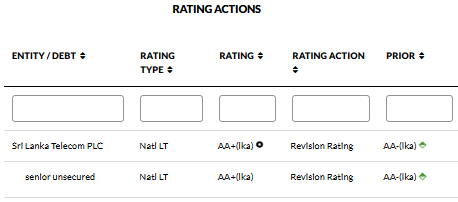
Fitch Revises Sri Lanka Telecom to ‘AA+(lka)’ Following National Rating Scale Recalibration
Fitch Ratings has revised Sri Lanka Telecom PLC’s (SLT) National Long-Term Rating to ‘AA+(lka)’ from ‘AA-(lka)’ following the recalibration of the Sri Lankan National Rating scale. The Outlook is Stable.
The recalibration reflects changes in the relative creditworthiness among Sri Lankan issuers following Fitch’s upgrade of Sri Lanka’s sovereign Long-Term Local-Currency Issuer Default Rating (IDR) to ‘B-’/Stable from ‘CCC+’ on 22 September 2026. We expect ratings of all other Fitch-rated corporate issuers to remain unchanged on account of the recalibration; any rating changes for other issuers reflect the performance of respective entities.
We also resolved the Rating Watch Positive on our earlier ratings following the decision of the state not to proceed with SLT’s sale. Consequently, SLT’s ratings continue to be constrained by its parent’s weaker credit profile under Fitch’s Parent and Subsidiary Linkage (PSL) Rating Criteria and Government-Related Entities (GRE) Rating Criteria.
SLT’s Standalone Credit Profile (SCP) is stronger than that of the state, reflecting the company’s market leadership in fixed telephone and broadband services, second-largest share in mobile, ownership of an extensive optical fibre network and a stronger financial profile.
Key Rating Drivers
Disposal Plan Abandoned: The previous administration’s plan to divest the government’s stake in SLT was formally abandoned following the Supreme Court’s ruling in April 2026. Fitch believes this reflects a strategic shift by the state to retain and strengthen SLT as a key national asset central to Sri Lanka’s digital transformation agenda, rather than pursue privatisation.
Investment to Support Market Position: Fitch expects SLT’s investment in national digital infrastructure to support the government’s commitment to guarantee minimum broadband speeds of around 2Mbps nationwide within the next two to three years, helping to narrow the digital divide. These initiatives reinforce SLT’s role as a key strategic partner in advancing Sri Lanka’s digital economy, which the government aims to grow to USD15 billion by 2030.
We believe SLT’s strong financial capacity will support continued investment, including in recently acquired 3.5GHz 5G spectrum to strengthen its operations.
Profitability to Strengthen: We forecast Fitch-defined EBITDA margin to expand to 38% in 2026 (2025: 34%), driven by revenue growth and cost controls, including operating and maintenance expenses. Fitch expects growing fibre broadband and mobile subscriber bases, along with ARPU improvements, to support revenue growth from 2026. Fitch expects operating margins to remain strong, supported by price adjustments aligned with evolving consumption patterns, which should help offset cost pressures stemming from Middle East-related tensions.
Interest Costs to Decline: Fitch expects financing costs to remain broadly unchanged in the near term. However, Fitch expects aggressive settlement of both short- and long-term debt, supported by improved cash flow, to drive a decline in interest costs over the medium term. Fitch forecasts cash interest expenses to slow to LKR5.2 billion in 2026 (2025: LKR5.8 billion), reflecting debt settlement trends in 1H26.
Improving Sector Outlook: Fitch expects the telecom sector in Sri Lanka to experience continued topline improvement. This will be driven by evolving data consumption patterns following 5G implementation and the government’s sustained focus on its digital transformation agenda.
Falling Leverage; Rising Sector Margins: Fitch forecasts 2026 EBITDA net leverage for SLT and mobile sector leader Dialog Axiata PLC (Dialog, AAA(lka)/Stable) to improve to around 0.9x and 0.4x, respectively, from around 1.6x and 0.7x in 2025, supported by margin recovery and disciplined capex management. Fitch expects the sector’s average EBITDA margin to improve to above 43% in 2026, from 40% in 2025, driven by 5G- and fixed broadband-linked revenue expansion and cost reductions, despite pressure from Sri Lankan rupee depreciation.
Peer Analysis
SLT’s rating is comparable with ‘AAA(lka)’ to ‘AA-(lka)’ rated peers such as Dialog, Sunshine Holdings PLC (AA+(lka)/Stable) and Singer (Sri Lanka) PLC (AA-(lka)/Stable). SLT is rated lower than Dialog, due mainly to drag by the sovereign parent’s rating.
Sunshine is much smaller than SLT. However, Sunshine is rated at the same level because its leverage and liquidity ratios are stronger than those of SLT. Sunshine also maintains a stronger market presence across its key operating segments, including healthcare, consumer and agriculture.
SLT’s unconstrained SCP is supported by its strong market position in fixed telephone and broadband and second largest in mobile services, along with its extensive optical fibre network that provides access to other internet service providers. SLT has a slightly weaker market position than Dialog, as its dominance is mainly in the legacy fixed telephone market, whereas Dialog controls over 60% of mobile market and 50% of the fixed broadband market. Dialog also has a larger revenue base, lower forecast EBITDA net leverage and a better FCF profile than SLT.
SLT is rated two notches higher than Singer, the country’s largest consumer-durables retailer. The two companies are broadly comparable in revenue terms. However, SLT benefits from a higher operating margin, while Singer’s credit profile is constrained by the drag from its finance subsidiary, which contributes to substantially higher net debt levels, albeit against a still-adequate fixed-charge coverage ratio.
Fitch’s Key Rating-Case Assumptions
– Revenue growth to improve to 9% in 2026 (2025: 2%) and sustained at a high-single-digit rate in 2027-2029.
– Operating EBITDA margin to expand to 38% in 2026 (2025: 34%), primarily due to revenue improvement and cost optimisation, and remain at this level in 2027-2029.
– Effective tax rate of 30% from 2026-2029
– Capex intensity to increase marginally to 16% in 2026 (2025: 15%), before moderating to 15% from 2029 as SLT completes most of its 5G and fibre investments and begins rationalising its capex investment.
– SLT to continue a 15% dividend payout in 2026, before raising it to a 20% payout ratio based on pretax profit in 2027-2029.
RATING SENSITIVITIES
Factors that Could, Individually or Collectively, Lead to Negative Rating Action/Downgrade:
– A downgrade of Sri Lankan sovereign’s Long-Term Local-Currency IDR could result in a downgrade of SLT’s National Long-Term Ratings;
– A weakening of links between SLT and the sovereign could result in an upgrade of SLT’s National Long-Term Ratings.
Factors that Could, Individually or Collectively, Lead to Positive Rating Action/Upgrade:
– An upgrade of the Sri Lankan sovereign’s Long-Term Local-Currency IDR could result in an upgrade of SLT’s National Long-Term Ratings.
Liquidity and Debt Structure
SLT’s unrestricted cash balance of LKR19 billion at end-June 2026, including LKR7 billion of fixed deposits reported as other investments, is sufficient to cover its LKR10 billion of short-term borrowings, including vendor financing maturing within the next 12 months. SLT is likely to depend on refinancing to roll over the long-term debt.
We expect SLT’s access to local banks to remain solid as its business fundamentals and long-term prospects are still strong, supporting its liquidity. We believe SLT’s funding mix will gradually normalise, as inflation moderates.
Issuer Profile
SLT is an integrated telecom company operating in Sri Lanka, with a market-leading presence in fixed-voice and broadband service and the second-largest market position in the mobile market and a dominant market presence in digital TV services.
REFERENCES FOR SUBSTANTIALLY MATERIAL SOURCE CITED AS KEY DRIVER OF RATING
The principal sources of information used in the analysis are described in the Applicable Criteria.
Public Ratings with Credit Linkage to other ratings
SLT’s ratings are influenced by the sovereign’s credit profile, in line with Fitch’s PSL criteria.
MACROECONOMIC ASSUMPTIONS AND SECTOR FORECASTS
Click here to access Fitch’s latest quarterly Global Corporates Sector Forecasts Monitor data file which aggregates key data points used in our credit analysis. Fitch’s macroeconomic forecasts, commodity price assumptions, default rate forecasts, sector key performance indicators and sector-level forecasts are among the data items included.