Fitch Takes Action on 8 Sri Lankan Banks’ National Ratings on Updated Scale After Sovereign Upgrade
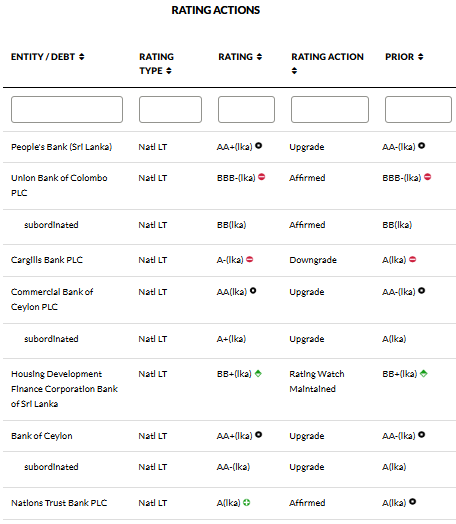
Fitch Ratings has taken the following actions on the National Long-Term Ratings of eight Sri Lankan banks following recalibration of the agency’s Sri Lankan national rating scale in the wake of the recent sovereign rating upgrade:
— Bank of Ceylon (BOC): National Long-Term Rating upgraded to ‘AA+(lka) from ‘AA-(lka)’; Outlook Stable
— People’s Bank (Sri Lanka) (PB): National Long-Term Rating upgraded to ‘AA+(lka) from ‘AA-(lka)’; Outlook Stable
— Commercial Bank of Ceylon PLC (COMB): National Long-Term Rating upgraded to ‘AA(lka) from ‘AA-(lka)’; Outlook Stable
— Nations Trust Bank PLC (NTB): National Long-Term Rating affirmed at ‘A(lka); Outlook revised to Positive from Stable
— Union Bank of Colombo PLC (UB): National Long-Term Rating affirmed at ‘BBB-(lka); Outlook Negative
— Cargills Bank PLC (CBP): National Long-Term Rating downgraded to ‘A-(lka)’ from ‘A(lka)’; Outlook Negative
— Housing Development Finance Corporation Bank of Sri Lanka (HDFC): National Long-Term Rating of ‘BB+(lka)’ maintained on Rating Watch Positive (RWP)
— State Mortgage & Investment Bank (SMIB): National Long-Term Rating of ‘BB(lka)’ maintained on RWP.
The National Ratings of all other Sri Lankan banks are not affected by this review.
The banks’ National Ratings consider their creditworthiness relative to other issuers in the country. National scale ratings are a risk ranking of issuers in a particular market designed to help local investors differentiate risk. Sri Lanka’s national scale ratings are denoted by the unique identifier ‘(lka)’. Fitch adds this identifier to reflect the unique nature of the Sri Lankan national scale. National scales are not comparable with Fitch’s international rating scales or with other countries’ national rating scales.
The national scale recalibration reflects changes in the relative creditworthiness of Sri Lankan issuers after Fitch upgraded Sri Lanka’s Long-Term Local-Currency Issuer Default Rating (IDR) to ‘B-’ with Stable Outlook from ‘CCC+’ on 22 September 2026. For details, see “Fitch Ratings Recalibrates Sri Lanka’s National Rating Scale“, dated 21 October 2026.
Key Rating Drivers
The National Long-Term Ratings on BOC, PB and COMB reflect the relative creditworthiness of the banks, which are among the largest domestically, compared with other Sri Lankan issuers on the revised national rating scale. We believe the sovereign’s improved credit profile eases macroeconomic risks to the banks’ operating environment (OE), which was recently raised to ‘b-’ from ‘ccc+’, and reduces asset-quality risk from the banks’ direct and indirect sovereign exposures.
BOC and PB
BOC’s and PB’s National Long-Term Ratings are driven by their standalone credit profiles. Their rating upgrades reflect greater room for positive differentiation on the recalibrated national rating scale to recognise the banks’ significantly stronger domestic franchises relative to the large private-sector banks This reflects the banks’ market-leading customer reach, branch networks and deposit franchises, dominant market positions that benefit their funding positions, and easing asset-quality risks from their larger-than-peer state-linked exposures.
This review only considers the National Ratings of BOC and does not affect its international-scale Issuer Default Ratings. For details on its Issuer Default Rating, please see “Fitch Upgrades Bank of Ceylon’s IDRs to ‘B-’; VR to ‘b-’; Outlook Stable“, dated 1 October 2026.
COMB
The upgrade of COMB’s National Long-Term Rating also reflects space for greater positive differentiation of the bank’s standalone credit profile relative to large private-sector bank peers. The rating takes into account COMB’s longstanding strength as Sri Lanka’s largest private-sector bank, with a sustained advantage in business and funding sourcing. Its funding costs have remained consistently lower than other large private-sector banks, and its asset quality, profitability and capital coverage of net impaired loans have generally remained at the better end of the range of rated local banks.
NTB
NTB’s National Long-Term Rating balances its better-than-peer financial profile and its moderate market franchise, with less than 5% of system assets, loans and deposits. Its market presence has expanded relative to peers in recent years through organic growth and the acquisition of HSBC’s Sri Lanka retail business. However, customer behaviour post-acquisition and the quality of recent growth may become clearer only in the next 12-18 months.
The revision in NTB’s rating Outlook to Positive from Stable reflects Fitch’s view that the credit profile may strengthen relative to peers on the back of a sustained broader franchise after acquiring HSBC Sri Lanka earlier this year, provided that its financial metrics remain generally better than peers’.
UB
UB’s National Long-Term Rating reflects the bank’s modest domestic franchise with roughly 1% of system assets, loans and deposits, higher growth appetite, and weaker asset quality and profitability relative to higher-rated peers. Asset quality and profitability metrics have improved in recent years, but high loan growth could continue to erode capital buffers, which underpins the Negative Outlook on the rating. The bank has outlined plans to expand the capital base to be more in line with balance sheet growth in the next 6-12 months, but these measures are subject to timing and execution risk.
CBP
The downgrade and Negative Outlook on CBP’s National Long-Term Rating reflects increasing constraints from the bank’s growing size on its ultimate parent, CT Holdings PLC’s (CTH) ability to support the bank in times of need. CBP’s assets accounted for a significant 66% of CT group assets at end-1H26 (bank equity: 28% of group equity).
We believe the group retains the propensity to support the bank given their shared branding, business synergies, moderate management integration and record of timely support. Even so, the group has trimmed its shareholding in CBP to around 50% as of 1Q26 (end-2025: 60.7%) as part of a requirement by the regulator to reduce its combined stake in the bank to 15% by 2029. Prospects for extraordinary support are likely to diminish further as the group’s shareholding falls below a controlling stake. Fitch regards CBP’s standalone credit profile as significantly weaker than its support-driven rating, due to its small franchise and weak financial profile.
HDFC and SMIB
HDFC and SMIB’s National Long-Term Ratings reflect their higher-risk profiles, niche franchises and concentrated exposures to vulnerable market segments due to their status as specialised banks.
The RWP on their ratings reflects Fitch’s expectation that the proposed acquisition of HDFC and SMIB by BOC and PB, respectively, could result in significantly higher support-driven National Ratings upon completion of the transactions, given the potential for extraordinary support. For further details, see “Fitch Places HDFC’s and SMIB’s National Ratings on Rating Watch Positive on Proposed Acquisition“, dated 21 November 2025.
Rating Sensitivities
Factors that Could, Individually or Collectively, Lead to Negative Rating Action/Downgrade
The National Ratings are sensitive to a change in the banks’ creditworthiness relative to other Sri Lankan issuers.
A downgrade of BOC, PB and COMB’s National Ratings is most likely to stem from a deterioration in Sri Lanka’s sovereign rating, through its influence on the banks’ OE, sovereign-related exposures and financial profiles.
Fitch may revise NTB’s National Rating Outlook to Stable if it is unable to retain its recently expanded scale, or if its financial metrics weaken to be no better than the peer average.
UB’s National Rating may be downgraded if its capital augmentation and retention plans continue to lag its risk appetite and loan growth, resulting in further weakening in capitalisation and loss-absorption buffers relative to peers.
CBP’s rating is sensitive to changes in CTH’s credit profile as well as Fitch’s opinion around CTH’s ability and propensity to extend timely extraordinary support. A continued rise in CBP’s balance sheet relative to that of CTH could make extraordinary support more onerous for the parent, which could lead to a multiple-notch downgrade in the National Rating to reflect the bank’s standalone credit strength. Further dilution in CT group’s stake could also reduce the shareholder’s propensity to support the bank in times of need.
Negative rating sensitivities for HDFC and SMIB are as described in the last rating action commentary.
Factors that Could, Individually or Collectively, Lead to Positive Rating Action/Upgrade
The National Ratings may be upgraded if the banks’ credit profiles strengthen relative to the universe of other issuers on the Sri Lankan national rating scale.
That said, there is limited upside to BOC, PB and COMB’s standalone-driven ratings as they are already high relative to other entities on the national rating scale.
Fitch may upgrade NTB’s National Rating if it is able to retain its improved market position while maintaining adequate underwriting and risk controls, and stronger financial metrics relative to peers.
An upgrade of UB’s National Rating is less likely in the near term in light of the Negative Outlook, but the Outlook may be revised to Stable if the bank moderates its loan growth for a sustained basis or executes on its capital augmentation plans to maintain adequate capital loss-absorption buffers relative to peers. This is provided its recent asset quality and profitability improvements are maintained without an undue increase in risk-taking.
There is limited upside to CBP’s rating in the near term given the Negative Outlook. Fitch would revise the Outlook to Stable if CTH’s scale expands significantly, such that any extraordinary support for CBP would become more manageable relative to the parent’s overall financial capacity.
Positive rating sensitivities on HDFC and SMIB are as described in the last rating action commentary. Fitch will resolve the RWP on HDFC and SMIB once the transactions are complete or no longer expected to proceed, which may take longer than six months.
OTHER DEBT AND ISSUER RATINGS: KEY RATING DRIVERS
Subordinated Debt
The Basel III Sri Lankan rupee-denominated subordinated debt of BOC, COMB, NTB and UB are rated two notches below the banks’ National Long-Term Ratings, in line with Fitch’s baseline notching for loss severity for this type of debt and our expectations of poor recovery. There is no additional notching for non-performance risk, as the notes do not incorporate going-concern loss-absorption features.
OTHER DEBT AND ISSUER RATINGS: RATING SENSITIVITIES
The subordinated debt ratings will be downgraded if the banks’ National Long-Term Ratings are downgraded. An upgrade of the banks’ National Long-Term Ratings will result in similar action on the subordinated debt ratings.
REFERENCES FOR SUBSTANTIALLY MATERIAL SOURCE CITED AS KEY DRIVER OF RATING
The principal sources of information used in the analysis are described in the Applicable Criteria.
Public Ratings with Credit Linkage to other ratings
CBP’s ratings are linked to Fitch’s assessment of CTH’s credit profile.