Employer-supported Childcare: A Solution to Labour Shortages?
By Amanda Balasooriya
Kanthi is a 33-year-old working mother who resides in
Kuliyapitiya. Her two-year-old daughter is enrolled at a private crèche located
eight km away from her home. Distance apart, Kanthi is not satisfied with the
quality of the childcare and finds it expensive. With no other choice, she
drops off her toddler at the crèche every weekday with a heavy heart. Kanthi elaborated on some of her difficulties during a survey for an ongoing IPS
study examining employer-supported
childcare facilities for women in the Kurunegala district:
“Not every working mother has the luxury of having grandparents to
look after their children. Most days, I find I am unable to fully concentrate
at work due to anxiety around my child’s wellbeing. Having employer-supported
childcare centres will ensure a child’s safety and peace of mind for parents.”
Kanthi’s story is the story of many Sri Lankan employed women
who struggle to manage paid work, household chores and childcare duties – due
to lack of adequate childcare support and entrenched socio-cultural gender
roles. Despite a growing
need for childcare, for many women, finding
quality and affordable childcare is difficult and childcare costs are very
high. At the same time, faced with labour shortages
employers are struggling to attract
women to the workforce. Some
companies have tried to overcome this
problem by offering childcare at the workplace. This blog, based on the
above-mentioned IPS study, tries to assess the feasibility of employer-assisted
child care, by estimating the willingness of women to pay for such childcare.
Childcare as an Impediment to Women’s Employment
Traditionally, care and domestic work are considered ‘women’s work’
and such care work has a direct and negative impact on women’s ability to
participate in labour market activities leading to gender gaps in employment
outcomes, wages and pensions. The presence of children under five years in the household lowers
the chances for Sri Lankan women to participate in the
labour force. Having at least one child under five in the household makes women 7.4% less
likely to join the labour force compared to women without young children, while
this has no significant association for men.
The need to provide affordable and quality childcare is recognised at
the national level. The National
Day Care Centre Policy (Draft) highlights the need for
accessible daycare services in the country and encourages women to take up or
return to employment through greater provision of daycare services. The National
Policy on Early Childhood Care and Development
(Draft) also flags the need for affordable and quality childcare.
Why Employer-supported Childcare is Attractive
Most Sri Lankan families are struggling to meet the costs of
childcare. A vast majority of women who wish to be employed do not enter the
labour market due to the lack
of quality and affordable childcare. Even
low-income families have to bear the high cost of childcare due to the absence
of affordable childcare arrangements.
Employer-supported childcare is an emerging choice available to
working mothers in private sector companies which helps to reduce work-family
conflicts and yields business benefits for employers. Due to the lack of
affordable childcare, women are attracted to employer-supported childcare as it
helps them to concentrate on their work without worrying about their children.
Accordingly, employer-supported childcare would encourage women to enter the
labour market and enable working mothers to remain in the labour market.
Employee Perspectives from IPS Study
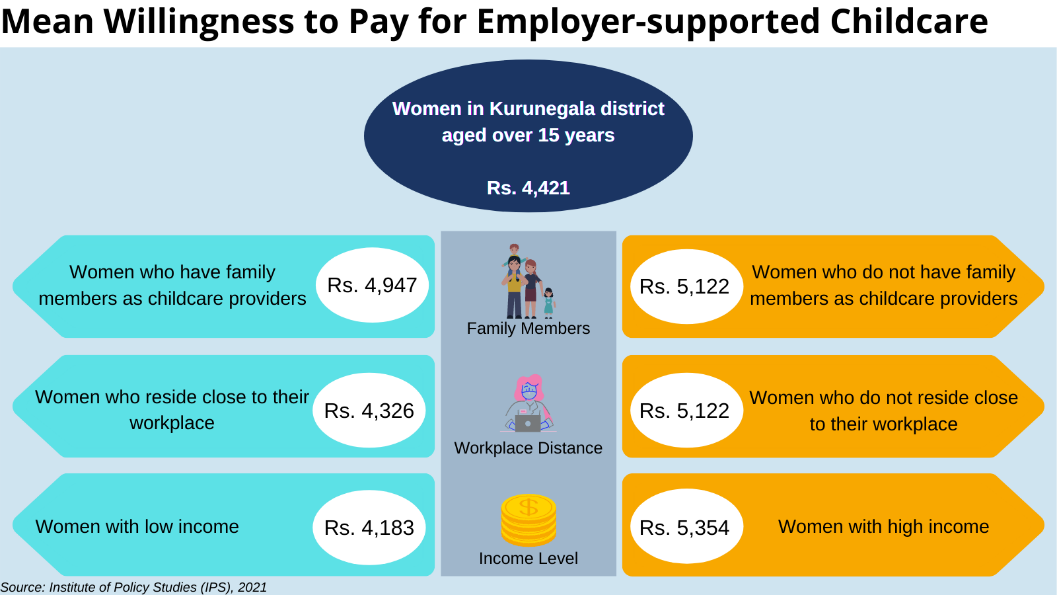
A new IPS study, based on a sample of 384 women from the
Kurunegala district, finds that the mean
willingness to pay for employer-supported childcare for women aged over 15
years is Rs. 4,421 per month. Using maximum likelihood
estimation, the study also found that a woman’s education, monthly income,
employment status and childbearing age are positively associated with the
woman’s willingness to pay for employer-supported childcare services. In
addition, family-related expenses negatively correlate with the willingness to
pay.