Pro-Poor Tourism: Can it Reduce Poverty in Sri Lanka?
By Kimuthu Kiringoda:
“Tourism has been described as the world’s largest transfer of resources from rich to poor, dwarfing international aid.” – Salli Felton, CEO, Travel Foundation
The tourism industry’s performance
was hampered first by the Easter Sunday bomb explosions in 2019 and then the
COVID-19 pandemic. Sri Lanka saw a decline in tourist
arrivals from 1,913,702 in 2019 to 194,495 in 2021. It is estimated
that revenue declined from USD 3600 million to USD 261 million during
2019-2021, reflecting a staggering 92.75% reduction due to a fall in arrivals.
At present, the government is
severely challenged with maintaining funds for basic provisions, and expansive
investments in tourism cannot be expected in the foreseeable future. In
November 2021, the Ministry of Tourism released the draft National Policy on
Tourism for Sri Lanka with recommendations for improvement. Among them are the
promotion of sustainable local tourism in Sri Lanka and community engagement.
This article discusses existing disparities in tourism and the possibility of
adopting a sustainable, pro-poor tourism strategy to reduce poverty in Sri
Lanka.
Poor-poor
Tourism
‘Pro-poor tourism’ aims
to uplift livelihoods by garnering net benefits to the poor through tourism. It
is not an act of charity to help the poor but to empower them with the
knowledge, skills, and recognition to utilise their existing capacities to
serve in the tourism industry. While the government can provide an impetus
through regulations and infrastructure, the capacities must be commercially
viable and not run on government aid.
The key objective of pro-poor
tourism is empowering the communities. They must be aware and proactive
participants. Communities are not required to be ‘tourist destinations’ solely
functioning for the purpose. Still, they can benefit from the indirect effects
of tourism – for example, by increasing poultry meat sales demanded by local
eateries. On the other hand, if tourist arrivals fall, the loss of revenue will
have to be borne by them. Participation is voluntary, and therefore, it is the individual
who must maintain a balanced approach to manage the income.
An example of government
intervention is South Africa’s Broad-Based Black Economic
Empowerment strategy. The engagement of marginalised communities is
measured through indicators such as ownership management, employment equity,
etc., to rate establishments. For instance, a considerable number of black
women as a percentage of the Board of Directors will give a higher rating to
the tourist establishment or be fined if it falls short. A mandated quota to
include women may offer relief to female poverty.
The ‘Sri Lanka Tourism: Strategic Plan
2017-2020’ emphasises the need to uplift livelihoods through
tourism, with a focus on engaging local communities, supporting local
businesses, and promoting the cultural values of the country. The active
participation of minorities and women in traditional arts, crafts, and cottage
industries is also recognised as key aspects in the poverty-focused tourism
strategy.
Existing Regional Disparities
On the ground, there is a notable regional
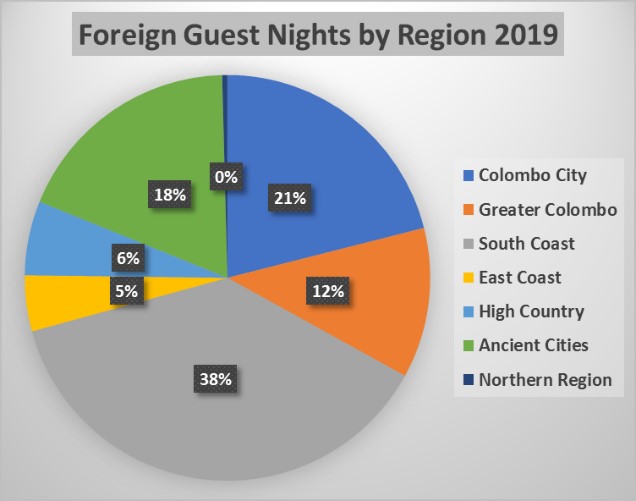
disparity in the operations of the tourism industry. The foreign guest nights
spent, as per region in 2019 shows approximately 73% of foreign guest
nights are spent in Colombo and the South Coast. Foreign guest nights spent in
the North are almost zero as a percentage (See Figure 1). The area that
foreigners choose to reside in is important because they tend to purchase
commodities in the vicinity such as local goods use local services such as
transportation, laundry, food, and beverages.
Figure 1: Foreign Guest Nights by Region, 2019
Source: Sri Lanka Tourism Development Authority (2020)
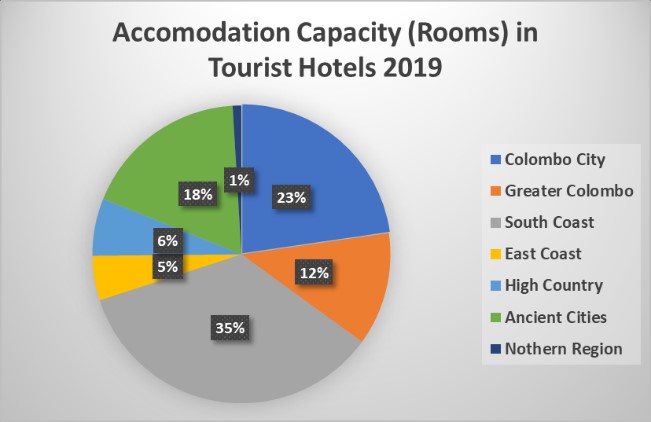
The
accommodation capacity of tourist hotels also indicates a regional disparity
(See Figure 2). However, these numbers are only related to 474 tourist hotels. There are
2,145 other supplementary tourist establishments that provide 24,831 rooms for
guests. Unfortunately, data
pertaining to the regional distribution of these establishments are not
available. The number can be higher where unregistered establishments might be
in operation.
Figure 2: Accommodation Capacity in Tourist Hotels, 2019
Source: Sri Lanka Tourism Development Authority (2020)
Increasing
Local Engagement