
A Fiscal Council for Sri Lanka: Pathway to Regaining Fiscal Credibility
By Dr. Lakmini Fernando:
Sri Lanka was once considered a
development success story. But within the last few decades, this legacy was
lost to governance failures and economic mismanagement. In recent years, the
country has been characterised by a glaring lack of fiscal discipline reflected
in rising deficits, debt, inefficient state expenditure and an inability to
raise sufficient revenue even to cover current spending. In this context, institutions have a major role in ensuring
that governments do not fail. Effective institutions can (1) assure the
provision of quality services which is essential for eradicating poverty and
promoting shared prosperity; (2) guarantee high-quality public spending and
minimise corruption; and (3) ensure that all citizens benefit from economic
growth and that development is not lop-sided. With this understanding, this blog
discusses how a Fiscal Council (FC) can help Sri Lanka regain fiscal
credibility and improve its overall economic performance.
Sri Lanka’s Fiscal Dilemmas
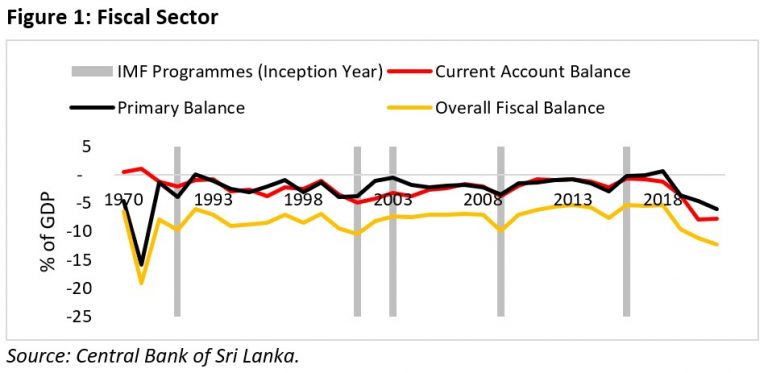
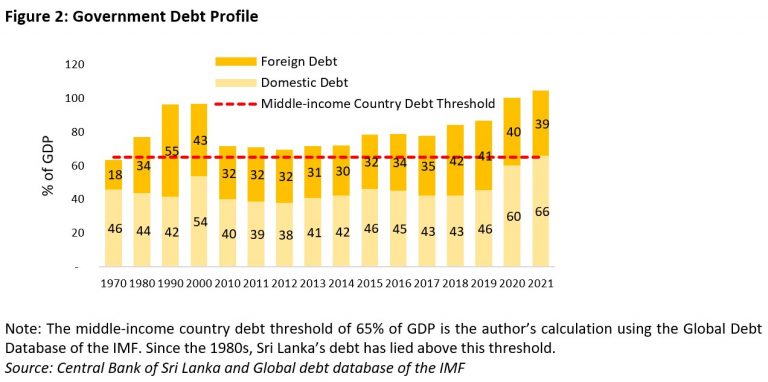
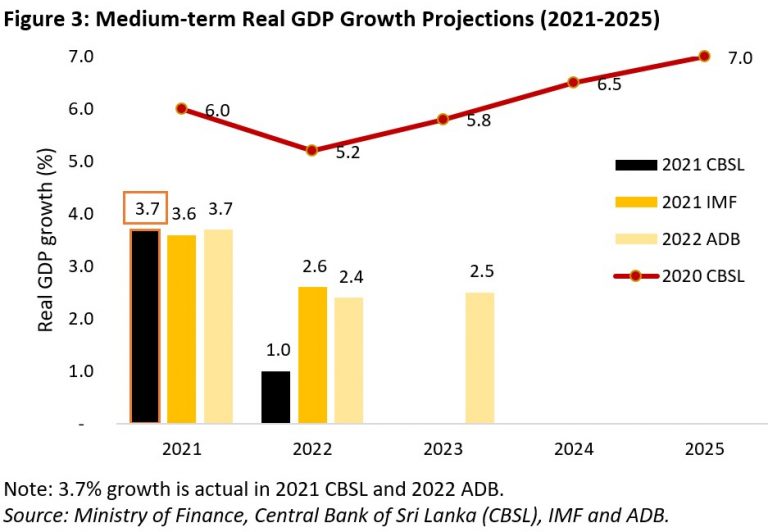
The Easter Sunday bomb attacks in April 2019 and the onset of the COVID-19 pandemic in March 2020 worsened Sri Lanka’s already precarious fiscal position. By 2021, government revenue had plummeted to 8.7% of GDP (from 17.2% in 2000), and Sri Lanka’s fiscal deficit was 12.2% of GDP (Figure 1). In 2021, the overall debt was 104.6% of GDP, while foreign debt was 38.6% of GDP (Figure 2). Since the 1980s, Sri Lanka’s debt has been above the safe debt threshold of 65% of GDP for middle-income countries. Sri Lanka’s macroeconomic projections consistently appeared too optimistic compared to the International Monetary Fund (IMF) and the Asian Development Bank (ADB) forecasts, with projections not shared or partially shared during periods of high uncertainty (Figure 3).
The
bottom line is that stabilising the Sri Lankan economy is impossible without a
clear macroeconomic framework. Some elementary questions in this regard are: “Is there a mechanism
to detect economic misconduct?”; “Are independent evaluations of fiscal policy
possible?”; and “Are the existing institutions capable of monitoring
macroeconomic dynamics?”. The answers to these questions are negative, thus
indicating the lack of a solid institutional mechanism to guide the fiscal
policymaking process. Without such an institution, ensuring sound management of
public finance is challenging.
FCs for Fiscal Discipline
| EU | No. | Non-EU | No. | |
| 1960 – 1989 | Austria, Belgium, Denmark, Netherlands | 4 | United States | 1 |
| 1990 – 1999 | – | 0 | Iran, Georgia, Mexico, | 3 |
| 2000 – 2009 | Hungary, Sweden | 2 | Korea, Kenya, Uganda, Vietnam, Canada | 5 |
| 2010 – 2021* | Bulgaria, Croatia, Cyprus, Czech Republic, Estonia, Finland, France, Germany, Greece, Iceland, Ireland, Italy, Latvia, Lithuania, Luxembourg, Malta, Portugal, Romania, Slovak Republic, Slovenia, Spain, United Kingdom | 23 | Australia, Bahamas, Brazil, Chile, Colombia, Costa Rica, Grenada, Panama, Peru, Serbia, South Africa, Uruguay | 11 |
Note: * 34 new FCs were established after the global financial crisis.
Source: International Monetary Fund Data.
FCs are publicly funded institutions staffed with technically competent persons who can guide fiscal policymaking. FCs are established to achieve three main objectives: to strengthen sustainable finances, provide macroeconomic forecasts and engage independent stakeholders in policy development. The structure, resources, and design of the FCs are crucial for success.
FCs follow three
broad institutional models: (1) Stand-alone
institutions originate from fiscal responsibility laws; (2). FCs under the
executive or legislative branch of the political system are established as a
part of parliament or a ministry; (3) FCs associated with other independent
institutions likecentral banks, audit institutions and statistical
agencies.
Well-designed
FCs can promote stronger fiscal discipline. FCs that are poorly designed, inadequately resourced and
do not focus on quantitative measures may not provide significant benefits. The
effectiveness depends on legal and operational independence, the strength of monitoring
quantitative budgetary targets, credibility in budgetary
forecasts and independence in sharing policy reviews.
Regaining Sri Lanka’s Fiscal Credibility
Institutional reforms are now widely
recognised as necessary for restoring and sustaining fiscal discipline. FCs have a potentially more significant
disciplining effect in developing economies with a relatively less-developed
infrastructure of unofficial bodies. The creation of an FC enables the pooling
of local expertise and access to financial and informational resources not
otherwise available to unofficial bodies. An FC can help Sri Lanka to create
sustainable public finance by improving the reliability of projected figures through a
consistent macroeconomic framework. It can provide impartial
government planning and expenditure scrutiny to the public and coordinate with
national and sub-national bodies for efficient expenditure management.
Good fiscal institutions are a necessary condition for achieving
disciplined fiscal performance. For instance, the delegation of macroeconomic
forecasting by an independent body reduces forecasting bias. There are
successful FCs in several Caribbean and small island developing nations,
including the Bahamas and Grenada. In 2018, Jamaica’s
intention to establish an independent FC helped improve fiscal sustainability
perceptions. Therefore, establishing an FC must be supported through a
strong and sustained political commitment for a country like Sri Lanka, where
institutions are much weaker.
Further, the inherent weaknesses in the existing institutions and the rarity of FCs in the Asian context should not prevent the introduction of innovative institutions to the country. Sri Lanka should therefore consider creating an independent institution to provide a sound fiscal policy and sustainable public finances, one capable of preparing baseline macro forecasts and verifying adherence to transparency standards and best budgeting practices. Creating an FC will signal the government’s firm commitment to sound economic management.This will positively impact the ongoing discussions with the IMF as FCs are considered critical partners during recovery. Therefore, establishing an FC would aid Sri Lanka in its efforts to restore sustainable and resilient public finances.
Lakmini Fernando is a Research Economist at IPS with primary areas of research interest in public finance, economic development, climate change and environmental economics. Lakmini holds a BSc in Agriculture from the University of Peradeniya, a Master of Development Economics (Advanced) from the University of Queensland, Australia and a PhD in Economics from the University of Adelaide, Australia. She is a recipient of the Australia Awards Scholarship from the Government of Australia and the Adelaide International Scholarship from the University of Adelaide.

So why don’t you start an FC? Someone has to lead it, why not you?