
Scalable capture: Sri Lanka’s marine plastic problem is compounding, so is the response
Once considered a ‘miracle material’ capable of solving every industrial and consumer problem of the 20th century, today, plastic has become a ‘technofossil’.
It has been found in snow at the top of Mount Everest, and as deep as the Marina Trench, across every known ecosystem, ultimately bio-accumulating up the food chain to humans as well. Plastic is already become the single most pervasive and problematic geological footprint of human civilization, and the problem is still growing.
In canals and waterways across Sri Lanka too, this slow moving ecological disaster continues to worsen. It is estimated that 9 million kilograms of plastic waste enters the Indian Ocean from Sri Lankan inland waterways every year[1], roughly equivalent to around 900 fully loaded garbage trucks, or about 0.4 kilograms of plastic per Sri Lankan.
Plastic waste accumulates and hits peaks with each rainfall. Most of it is carried from what many of us carelessly discard by roadsides and drains, and from informal settlements that too often have no formal waste collection systems. Blockage of waterways and drainage systems directly increase the likelihood of future flooding.
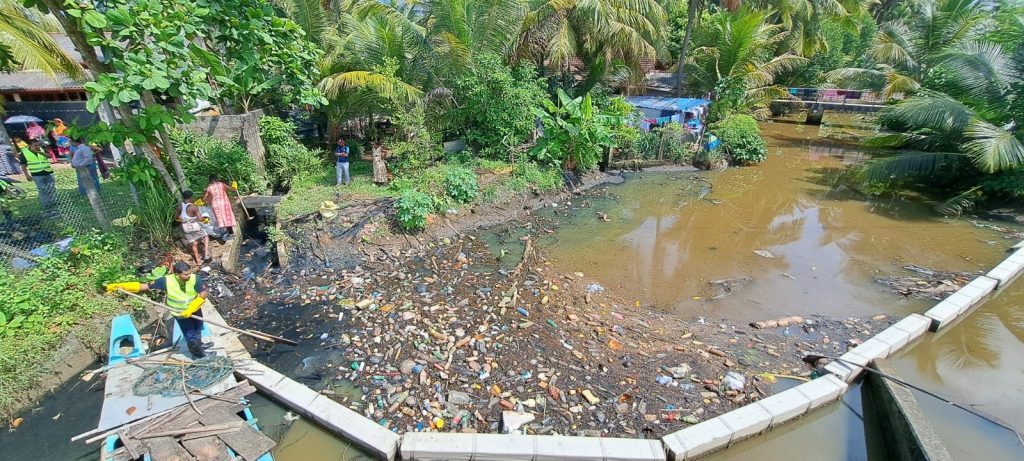
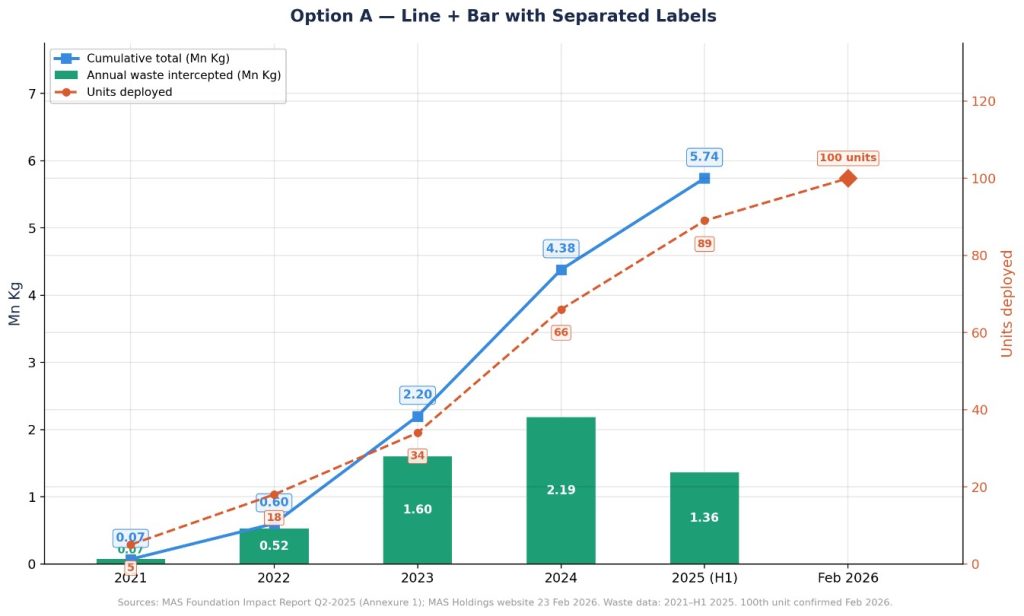
But since August 2020, a relatively simple but effective intervention has been gradually scaling up to combat this problem. A growing network of these MAS Ocean Strainers have been intercepting increasingly large volumes of floating trash in 100 locations across Sri Lanka.
A simple floating barrier, made partly from upcycled factory waste – and sometimes locally sourced bamboo, the plastic captured by these MAS Ocean Strainers is revealing important insights into the scale and extent of Sri Lanka’s plastic pollution, and the kind of solutions that could actually turn the tide in this battle.
Across these 100 installations, the composition of intercepted waste consistently shows 35–40% plastic and polythene — a proportion that holds across geographically diverse sites, from the dense urban waterways of central Colombo to canals in the Southern and Western provinces. This consistency points to a national pattern of consumption and disposal rather than a set of isolated local failures. Recyclable materials that could be diverted are being discarded into waterways rather than sorted, suggesting significant gaps in both public awareness and the availability of accessible collection infrastructure.
The distribution of waste capture varies significantly across the network. Two units in the Serpentine Canal cluster alone have captured 877,000 kilograms of waste. The St. Sebastian Canal complex — five units spread across its southern, northern, eastern, and central reaches — has captured nearly 1.5 million kilograms combined.
These concentrations reveal that strategic placement in high-volume urban canals yields dramatically more impact per unit than broad geographic distribution. They also underscore a deeper reality: the volume of waste entering Sri Lanka’s waterways far exceeds what interception alone can address. Prevention must be built into the system. The Ocean Strainers can only serve as a last line of defense.
“This programme has strengthened our ability to act systematically,” notes Sri Lanka Land Development Corporation Chairman, Eng. Saman Sri Senaweera. “With consistent data on where waste accumulates and what it contains, we can plan more effectively and build the kind of durable operational response this problem demands.”
Even as the Ocean Strainer programme continues to scale and adapt its design, the data it generates points to challenges that extend well beyond any single intervention. Sri Lanka’s National Action Plan on Plastic Waste Management (2021–2030) sets a target of 80% of plastic waste collected and recycled a target that has not yet been met.
The policy frameworks are in place; what remains is the shared work of closing the gap between ambition and implementation, a task that will require sustained coordination across government, industry, and communities.
Notably, waste collection infrastructure has yet to reach many communities that currently lack accessible, formal disposal options. This reality is most visible in the informal settlements lining many of Colombo’s canals. Strengthening waste segregation within municipal service delivery also remains an ongoing priority.
The data emerging from programmes like the Ocean Strainer can play a meaningful role in supporting these efforts, offering ground-level evidence to inform collaborative discussions around producer responsibility, packaging design, and recycling targets.
At the community level, upstream interventions that strengthen awareness and participation are beginning to take shape. Community surveys running alongside the programme are mapping local waste generation behaviour, producing insights that can feed directly into targeted local outreach. But lasting behaviour change is only sustainable when supported by accessible systems; communities need both the knowledge and the practical means to act differently.
“Ocean strainers and waste booms are an important temporary measure to prevent waste from reaching the ocean, but lasting change comes from reducing litter at its source,” says Sharika Senanayake, Executive Director of MAS Foundation for Change. “By combining community action with data-driven policy, our ultimate goal is simple: clean, free-flowing waterways that no longer carry waste to the sea.”
The 2.7 million kilograms intercepted annually is meaningful, and it marks real progress. But it is a starting point. Government, industry, and communities each hold part of the solution, and the data now exists to help all three act with greater precision.