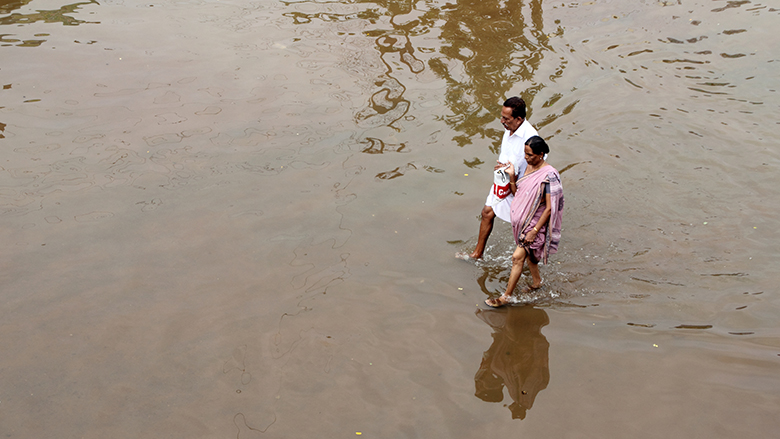
Feature: Building Sri Lanka’s resilience to climate change
By World Bank
38-year-old Sivasidambaram Vasugi is the General Manager of one of the first cooperative-owned seed paddy processing centers in Killinochchi, Si Lanka. The Integrated Farmers Thrift and Credit Cooperative Society (IFTCCS) provides local farmers with high-quality seeds, but these days, there are no buyers walking in the door.
Her community is facing a crippling water shortage following many months of drought. Nearly 18,000kg of processed paddy seed stock sits unclaimed on Vasugi’s factory floor, while weeds sprout in the paddy fields all around.
“Only when the rains come again, they will buy the seeds,” she says. “In the meantime, we have no sales, and we are not making any profits.” Farming households are coming undone thanks to this drought. Vasugi sees local men migrate to work as day laborers, while their families stay behind and fight to make ends meet. Many merely struggle to put food on the table.
Vasugi lives in a climate hotspot.
Areas like this are the focus of the World Bank’s new regional flagship report South Asia’s Hotspots: The Impact of Temperature and Precipitation Changes on Living Standards.
The report examines how 800 million people, or half the population of South Asia, could see their living standards worsen by 2050.
“These weather events have one thing in common: They affect the lives of the poorest and most vulnerable the most,” said Andrew Goodland, World Bank program leader for Sustainable Development covering Sri Lanka and Maldives.
Speaking at the launch of South Asia’s Hotspots he added: “We need to both scale up actions and strategies to build a more resilient world, and target interventions to help the most vulnerable.”
MULTIMEDIA
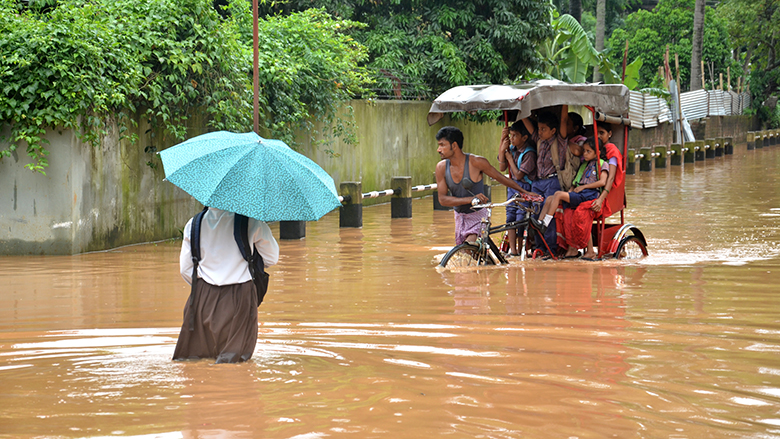
South Asia’s Hotspots
Climate change could undermine living standards for the poorest
Changes in average weather unfold over months and years. As Vasugi can testify, in such hotspots, rising temperatures and changing rainfall patterns can dampen agricultural productivity, leave farming households floundering and drive migration.
Simultaneously, a warmer climate can also increase the propagation of vector-borne and other infectious diseases. For those working outside air-conditioned cubicles, extreme heat takes a toll on productivity and subsequently, income. It doesn’t help that many hotspots are already in socially and economically vulnerable areas
At the frontlines in Sri Lanka are those living in the island’s North, North Eastern and North Central districts, including Jaffna, Puttalam, Mannar, Kurunegalla, Trincomalee and Killinochchi, where the paddy seed processing center is located.
Vasugi’s home has something in common with other hotspots across the region, such as Hyderabad in Pakistan, Cox’s Bazar in Bangladesh and Chandrapur in India. Households in these areas tend to report low household consumption, poor road connectivity, limited access to markets, and other development challenges. Combined, these conditions make them deeply vulnerable to climate change.
These experiences on the ground inevitably impact the national economy. “In Sri Lanka, living standards could go down by around 5 percent, and in the worst-case scenario may decline by around 7 percent,” said Muthukumara Mani, a lead economist in the World Bank South Asia Region and author of the report. “Under the worst-case scenario, GDP will decline by 7.7 percent, an estimated loss of 50 billion dollars.”
19 million Sri Lankans could live in moderate or severe hotspots by 2050
While policymakers are worried by this information, Mani knows it doesn’t necessarily help them prepare. So this report seeks to unpack where exactly changes will occur most, who will be impacted and what can be done to build resilience.
He and his team analyzed two future climate scenarios — one that is “climate-sensitive,” in which some collective action is taken to limit greenhouse gas emissions. The other is “carbon-intensive,” in which no action is taken. Both scenarios show rising temperatures throughout the region in the coming decades but it’s no surprise that the carbon-intensive scenario is more worrying.
While policymakers are worried by this information, Mani knows it doesn’t necessarily help them prepare. So this report seeks to unpack where exactly changes will occur most, who will be impacted and what can be done to build resilience.
He and his team analyzed two future climate scenarios — one that is “climate-sensitive,” in which some collective action is taken to limit greenhouse gas emissions. The other is “carbon-intensive,” in which no action is taken. Both scenarios show rising temperatures throughout the region in the coming decades but it’s no surprise that the carbon-intensive scenario is more worrying.
According to the report, approximately 19 million people in Sri Lanka today live in locations that could become moderate or severe hotspots by 2050 under the carbon-intensive scenario. This is equivalent to more than 90 percent of the country’s population.
Granular details include how effects will differ from country to country and from district to district throughout South Asia. In Sri Lanka, the Northern and North Western provinces emerge as the top two hotspots, followed by the much less densely populated North Central Province.
The highly urbanized and densely populated Western Province, which includes Colombo, is also predicted to experience a living standards decline of 7.5 percent by 2050, compared with a situation without changes in average weather. This is a substantial drop, with potentially large implications for the country, given that the province contributes more than 40 percent of Sri Lanka’s GDP.
Overall, the analysis concludes that Sri Lanka’s average annual temperatures could rise by 1.0°C to 1.5°C by 2050 – even if carbon emission reduction measures are taken as recommended by the Paris Agreement of 2015. If no measures are taken average temperatures in Sri Lanka could increase by up to 2.0°C.
Mani points out that this might not seem like a lot until you consider how just a two-week delay in monsoons can derail a farmer’s harvest, or how a scorching day can drain a construction worker laboring on a scaffolding.