Food Fight: Sri Lanka’s Battle for Food Security
By Lakshila Wanigasinghe
World Food Day is observed on 16 October to promote awareness and
action to ensure regular access to nutritious food for all. The blog examines Sri Lanka’s
struggle to safeguard food and nutrition security amidst the ongoing economic
crisis and outlines policy steps to tackle the challenge.
Sri
Lanka’s economic crisis continues to affect the lives and
livelihoods of its people, with the burden being highest on the poor and
vulnerable. The situation has progressed from bad to worse, with debt problems spiralling
down to impact every aspect of the economy adversely.
Sri Lanka’s Food Crisis
Global disruptions including COVID-19,
the climate crisis and Russia’s invasion of Ukraine earlier this year, have impacted food supplies
worldwide. However, Sri
Lanka’s food insecurity is largely a result
of the prevailing economic crisis coupled with short-sighted policies enforced
by local policymakers. The overnight ban on chemical fertiliser imports has
been costly and generated a lower harvest. Although the ban has since been
reversed, it continues to have ripple effects on the food system.
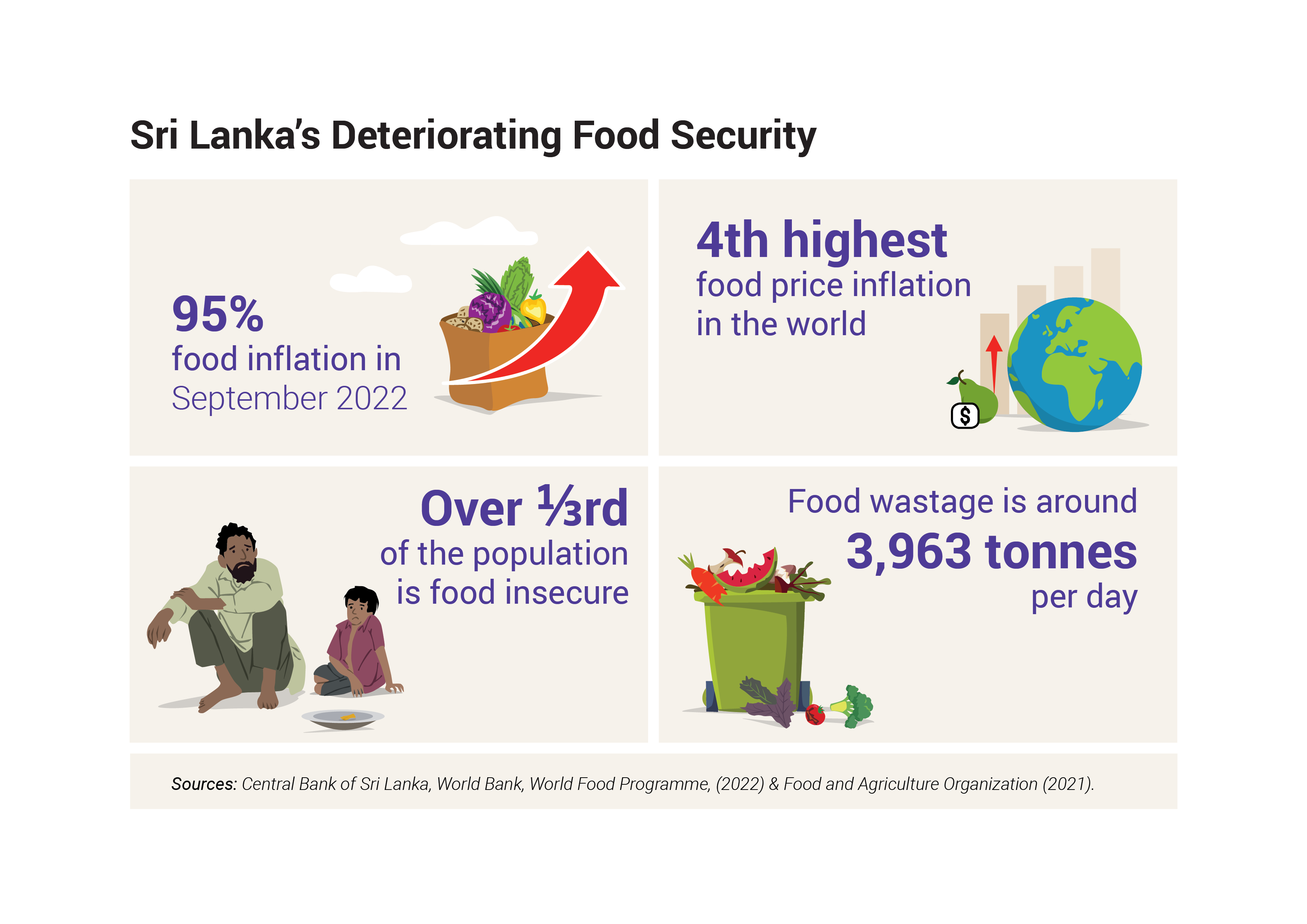
The drastic drop in domestic yield has driven policymakers to spend more money importing necessary commodities previously produced locally, including staples like rice. This move has been detrimental at a time when foreign reserves are lacking. Additionally, import controls imposed by the government have led to certain food items becoming scarce. These supply shortages have led to increases in the prices of essential foods. With food inflation reaching 95% in September, Sri Lanka ranks among the top five countries with the highest food price inflation.
As food becomes scarce and prices continue to rise, more
people – the poor in particular – cannot afford proper meals. Adding to the
problem are inflationary pressures, the inability of wages to keep up with
inflation and income losses induced by the economic crisis. Thus, households
are left in a predicament to reduce expenses, including cutting down on
consumption expenditure. A World Food Programme (WFP)
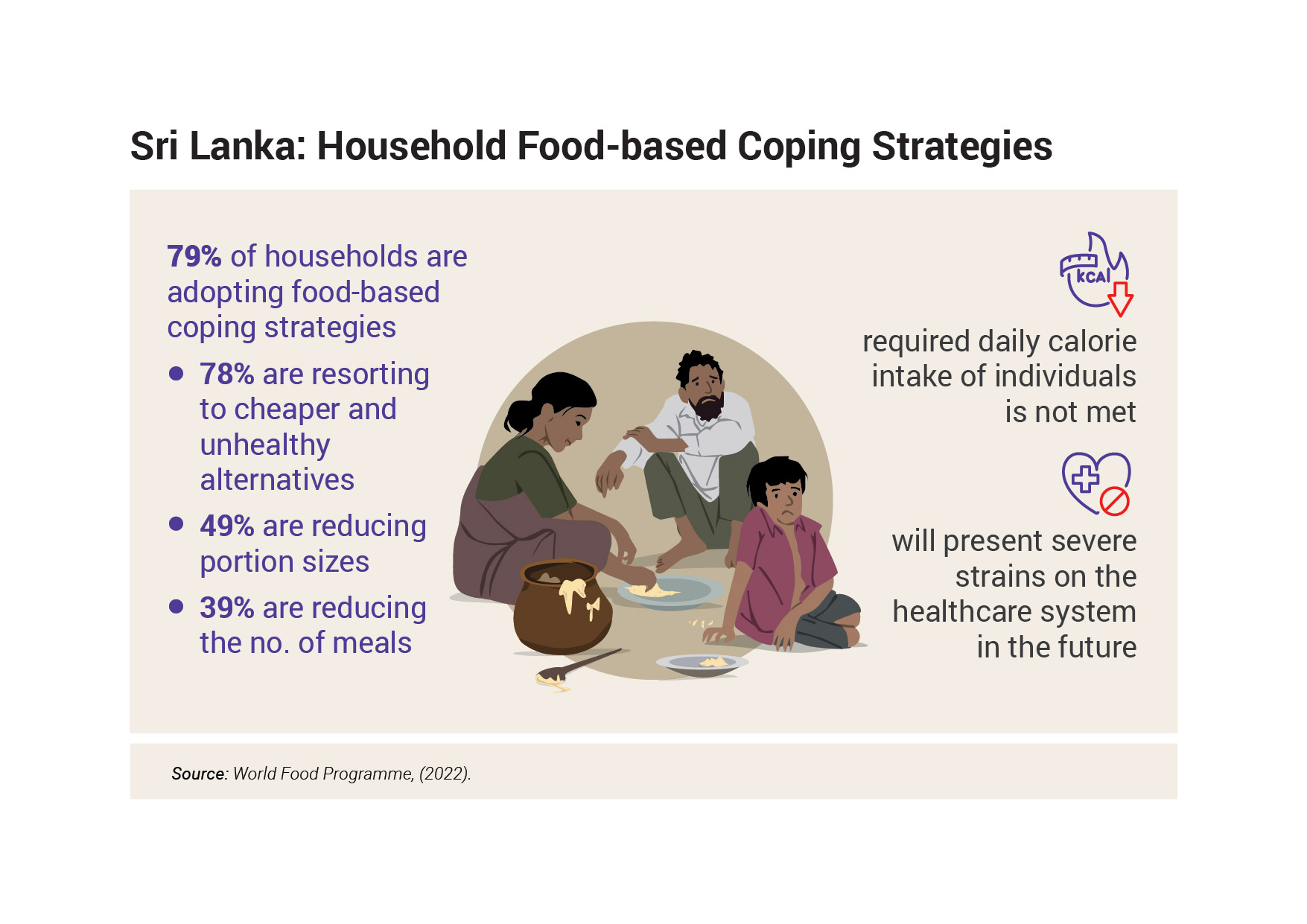
survey reveals that 79% of
households are adopting food-based coping strategies to deal with the crisis.
This affects both the quality and quantity of food consumed. Families are likely to resort to cheaper and unhealthy alternatives (78% of families) due to the inability to afford high-quality, nutritious food. They are also likely to reduce portion sizes (49%) or skip meals entirely (39%), resulting in individuals not meeting their required daily calorie intake. For children, eating less directly impacts growth and contributes to increasing the already high rates of child malnutrition in the country. For adults – considering the rapidly ageing population in Sri Lanka – undernourishment implies severe strains on the healthcare system in the future.
Government Action to Combat Food Insecurity
The interim Budget proposed to allocate LKR 46,600
million for crisis-related initiatives, including providing LKR 10,000 per food-insecure
family and an additional monthly allowance of LKR 2,500 for pregnant mothers for
four months respectively. A further LKR 400 million was allocated for the
Department of Agriculture to provide farmers with seeds/planting material
urgently and LKR 40 billion for fertiliser for paddy cultivation for the 2022/2023
‘Maha’ season. Additionally, the government recently initiated a National Food Security Programme. The interim Budget also proposed establishing youth agriculture
companies, writing off paddy farmers’ outstanding loans, etc. While the success
of these initiatives is yet to be realised, it will depend entirely on the effectiveness
of implementation. However, the pressure for timely success is high and
critical for combating food insecurity.
Overcoming Hunger and Achieving Food Security
While long-term strategies are needed to counter the
underlying causes of food insecurity and ensure sustainable domestic production,
swift action must be taken to tackle the challenge of ensuring people do not go
hungry at present. Supporting immediate food needs amid the prevailing economic
crisis requires a twofold effort: protecting the (1) poor and (2) farming
community. In this regard, targeted measures to support the poor and near-poor
through policy interventions and strengthened social safety nets are vital. The
government has already allocated funds in this regard; however, successful
implementation depends on accurately identifying groups at risk of starvation
and providing them with immediate food assistance through subsidised products
or cash transfers.
Attention should also be directed towards
middle-income earners, who often get left behind in aid processes but may be in
dire need of support given Sri
Lanka’s current economic standing. Measures
should also be taken to guarantee food availability across all parts of the
country, thus ensuring equitable access. Protecting farmers’ livelihoods
require adequate fertiliser availability at reasonable prices. More efficient
use of fertiliser and high-quality seeds also play a role in ensuring limited
supplies last longer. This will secure a harvest that can better support
domestic demand next season. The government can also repurpose idle land for
crop production and encourage small-scale farming.
Given the debt crisis, although import restrictions on
certain foods are needed, they tend to be counterproductive. As evident from
the global food crisis in 2008, trade restrictions drove up food prices rather
than subsidising them. Moreover, stricter regulations should be in place to
ensure consumers are not overcharged for high-demand items, as was evident for
milk powder and fuel earlier this year. Minimising the high levels of food
wastage (approximately 3,963 tonnes per day) also plays a crucial role in satisfying immediate
food needs. Not stockpiling food, purchasing homegrown products, and consuming
leftovers at a later stage/restaurants donating leftovers to the poor are ways
households and businesses can contribute to combating food insecurity.